A pool deck furniture guide should help you compare seating, preserve clear routes, and plan care for a wet outdoor setting. Furniture placement does not replace pool safety rules, supervision, or applicable local requirements. This guide covers practical layout considerations and product checks; no material or furniture weight guarantees a safe pool area or prevents movement in wind.
How Far Furniture Should Sit From the Water
The standard many builders and pool designers use is a minimum four-foot clear walkway between the pool coping and any furniture. That number isn’t arbitrary. It gives room for someone to climb out, walk past a lounger, and swing a towel without knocking anything into the water. If your deck is narrow, you can push chairs closer, but three feet is the practical floor before traffic starts feeling pinched.
For dining sets, plan on five to six feet between the pool edge and the back of a pulled-out chair. People push back further from a table than they do from a lounger, and a chair leg sliding backward toward water is exactly the situation you want to design out. Measure with a chair actually pulled out from the table, not just the table footprint.
Corners and steps deserve extra clearance. Pool entry steps are the busiest wet zone on the whole deck, and stacking furniture near them creates a bottleneck when swimmers are climbing in and out with kids or floats. Give steps at least six feet of clear radius. If you have a diving board or slide, keep the landing zone completely open – no furniture within the entire arc a jumper could reach, plus another two feet of buffer for splash and recovery.
Finally, think about shade drift. The sun moves several feet across your deck between 11 a.m. and 3 p.m., so the “perfect” chair spot in the morning may be baking by lunch. Placing seating a little further from the water often puts it closer to the shade line you actually want.

Slip-Safe Placement and Traffic Flow
Wet feet can make smooth pool-deck surfaces more slippery, and careful furniture placement helps keep walking paths clear. The goal is to keep the walking paths – from the house to the pool, from the pool to the towel area, from the deck to the yard – clear, straight, and predictable. When someone hops out of the water, they should be able to see their next three steps without weaving around chair legs.
A few placement habits that reduce slip risk:
- Keep at least a 36-inch walking lane on the primary path from the pool to the house or bathroom.
- Group chairs in pairs or clusters rather than lining them up like an airport gate – clusters leave natural walking gaps between them.
- Face lounge chairs the same direction inside a cluster so their feet don’t cross the walking lane.
- Put side tables on the shade side of a chair, not the pool side, so wet hands don’t reach across a walking path for a drink.
Rugs are a mixed bag on pool decks. An outdoor rug can define a lounge zone and add grip underfoot, but a soaked rug becomes a slip hazard of its own if it bunches. If you use one, pick a low-profile flatweave and keep it well back from the coping. The Consumer Product Safety Commission publishes helpful pool and spa safety guidance at cpsc.gov that’s worth reading before you finalize any layout, especially if kids use the pool regularly.
Also think about what happens at night. Low deck lighting along the furniture edges – not glare, just enough to see chair legs and coping – can make those boundaries easier to see after dark. Solar path lights placed at the corners of a seating cluster do this cheaply.
Materials That Actually Handle Pool Conditions
Pool decks are brutal on outdoor furniture. UV is relentless, splash is chlorinated or salted, and wet swimsuits leave every seat damp for hours. Not every “outdoor” material handles this well.
What tends to struggle
Untreated wood absorbs pool water, swells, and grays quickly. Painted wood peels along the edges where wet suits drag across it. Powder-coated steel can chip at joints and rust from the inside out once moisture reaches bare metal. Sling fabric holds up to sun reasonably well but sags over time and can trap chlorine that discolors the weave. Wicker – even resin wicker – collects grit and sunscreen in its weave that becomes almost impossible to clean out.
What tends to hold up
Solid poly lumber and quality HDPE-based furniture handle pool zones well because the color goes all the way through the material, they don’t absorb water, and chlorine and salt don’t corrode them. Aluminum frames with a marine-grade finish can also perform well if the finish is intact. Look for stainless hardware – regular steel screws will rust and streak a chair within a season near a pool.
What to look for on the spec sheet
When you’re shopping, check for UV inhibitors mixed into the material (not just applied as a coating), stainless or nylon fasteners, and a written warranty that specifically covers both structure and fade. Coverage in the range of a 7-year structural warranty and a 5-year fade warranty is a reasonable benchmark for solid poly outdoor seating. Anything much shorter than that on a poly product is worth questioning.

Seating Types and Where They Belong on the Deck
Not every seat suits every zone on a pool deck. Matching the piece to the activity keeps the space usable.
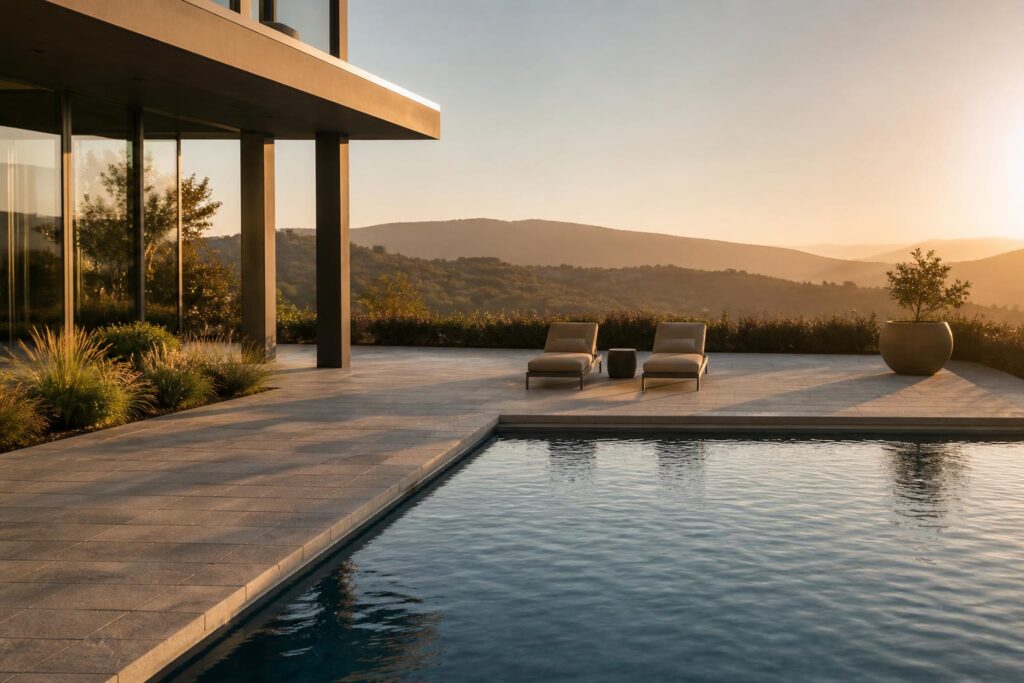
Loungers for the sunbathing zone. Chaise-style loungers make sense in the widest, sunniest part of the deck, spaced 18 to 24 inches apart so a side table or towel can fit between them. Point them toward the pool, not parallel to it – guests want to watch swimmers, not each other.
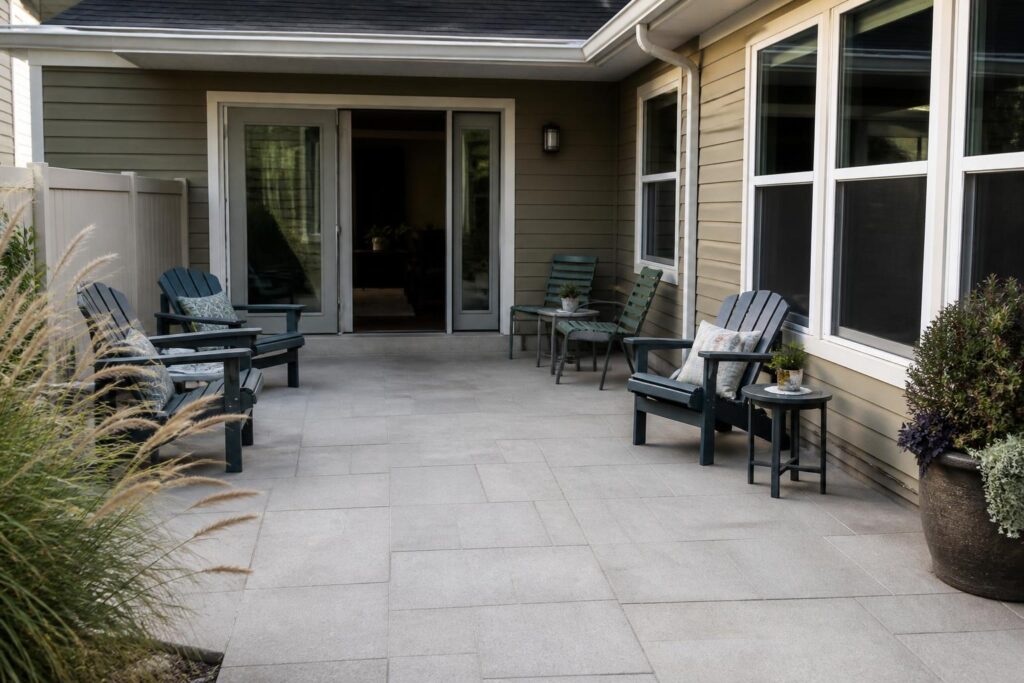
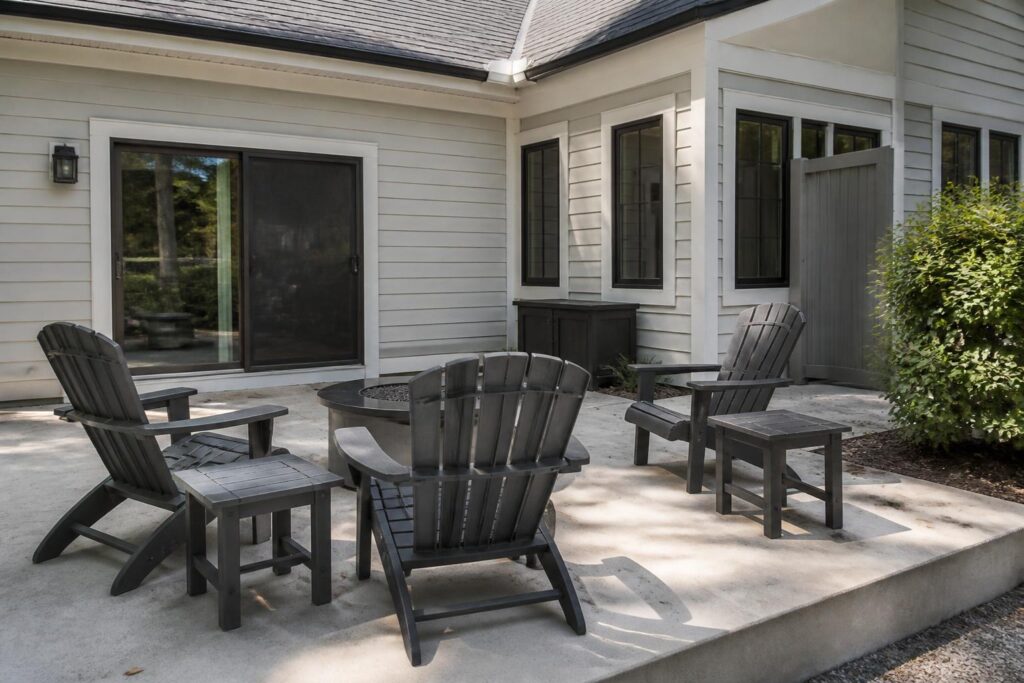
Adirondacks for the transition zone. The area between the pool deck and the yard or patio is where an Adirondack shines. It’s a chair you sit in wet or dry, it has a wide arm for a drink, and its reclined angle is comfortable for long conversations. A pair of Hampton Adirondack Chairs with a small table between them makes a natural landing spot after a swim, especially if you can angle them toward the sunset.
Café chairs and dining seats for the eating area. If your deck has a shaded dining spot, armless café-style chairs slide in and out easily and take up less footprint than dining armchairs. Give each seat a minimum of 24 inches of table edge and 36 inches behind for the chair to pull out.
Counter stools for a swim-up bar or outdoor kitchen. If you have a bar counter, ledge, or outdoor kitchen island facing the pool, counter height stools give swimmers a place to perch mid-snack without dripping across the whole deck. Plan on 24 inches of counter width per stool, and keep the counter height around 36 inches for standard counter stools.
The mistake most homeowners make is buying too much of one type – eight identical loungers and nothing else. Mix two or three seating types so the deck works for sunbathing, snacking, and conversation without rearranging every time guests come over.
Layout Rules That Make Small Decks Feel Bigger
A pool deck rarely feels as big as you’d like. Smart layout choices buy back usable square footage without adding an inch of concrete.
Start by identifying the three fixed points: where people enter the deck, where they enter the water, and where they’ll go to dry off (usually a towel hook, shower, or door back inside). Draw straight lines between those three points. Furniture never goes on those lines. Everything else is fair game.
Second, use the long walls. A row of loungers backed against the house or a fence, facing the pool, reads as open deck. The same loungers floating in the middle of the deck read as clutter. Keep the center clear whenever possible – it’s what makes a deck feel spacious.
Third, scale the pieces down near the water and up near the perimeter. Low-back chairs and small side tables near the coping preserve sight lines across the pool. Taller, larger pieces – dining sets, bar seating, umbrellas – work better against the deck’s outer edge where they don’t block the view.
Fourth, remember the sun. In hot climates, the deck surface itself can hit 130°F on a July afternoon, and dark chair colors will run hotter than light ones. If your deck bakes, favor lighter chair colors in the fully exposed zones and save darker tones for shaded areas. Solid poly cools off quickly once the sun moves off it, faster than metal in the same spot.
Cleaning, Storage, and Seasonal Care
Pool deck furniture gets dirty in a specific way: sunscreen residue, chlorine or salt film, pollen, and the occasional splash of drink or food. A weekly rinse with a garden hose knocks off the daily buildup. Every month or so, a bucket of warm water with a squirt of dish soap and a soft brush handles the sunscreen film that hoses alone won’t lift. Rinse and let air dry.
Avoid pressure washers on any furniture unless you know the material can take it – they can drive water into fasteners and pit softer finishes. For stubborn stains on poly, a mix of one part household bleach to ten parts water, applied with a soft brush and rinsed thoroughly, usually works. Test any cleaner on a hidden spot first.
In climates with real winter, most poly furniture can stay outside year-round, but it’s worth moving pieces off the pool deck itself before the cover goes on. That gives you room to work on the pool and keeps chairs out of ice-melt runoff. In hurricane or high-wind regions, plan a storage spot – a garage or shed – where you can move chairs quickly when a storm is coming. Even heavy chairs become projectiles in 60 mph gusts.
Check hardware once a season. Tighten any loose screws, and replace any fastener showing rust with a stainless equivalent. A five-minute tune-up in spring adds years to the life of the piece.
Frequently Asked Questions
How much clearance do I need behind a pool dining chair?
Plan on 36 inches behind each dining chair so someone can pull the chair out, stand up, and walk behind it without turning sideways. If the dining set sits with its back to the pool, bump that to 42 to 48 inches and try to leave five to six feet between the chair backs and the water. This buffer keeps someone stepping back from a chair from stumbling toward the coping, and it gives passing swimmers room to walk behind seated guests.
Will chlorine or salt water damage plastic outdoor furniture?
Quality solid poly and HDPE furniture generally handle chlorine and salt splash well because the material doesn’t absorb water and isn’t metallic. What you want to watch is the hardware. Regular steel screws will rust and streak even the best chair frame, so look for stainless or coated fasteners. Rinse furniture with fresh water after heavy pool use or salt exposure, and the surface will stay clean and the color will hold up much longer than painted or fabric alternatives.
Do I need umbrellas over pool furniture?
Not required, but useful. UV exposure at the pool is intense because water reflects sunlight back up onto anyone sitting nearby, effectively doubling the dose. A market umbrella over a dining set or a cantilever umbrella over a lounger cluster cuts glare and gives guests a break from direct sun. If you don’t want permanent shade structures, a shade sail anchored to the house and two posts is a lower-profile alternative that still blocks a large portion of midday UV.
How many chairs should I plan for around a pool?
A common rule is one seat per expected swimmer plus two extras for non-swimming guests. For a family of four who occasionally hosts, that’s six to eight seats total across all types. Split them: two to four loungers, two conversation chairs like Adirondacks, and a small dining or bar area. Buying more than you need clutters the deck and blocks walking paths; buying too few leaves guests standing around wet, which is exactly what good deck planning should prevent.
When you’re ready to fill in the deck, Plastic Furniture To Go offers Adirondacks, café chairs, counter stools, and end tables built in our American factory and shipped free anywhere in the country. Because everything ships factory-direct, you skip the retail markup on pieces you’ll be living with for years. Browse the full lineup on the Hampton Adirondack page or reach out through the contact form if you’d like help thinking through a specific layout – happy to talk it through before you order.