
Running through an outdoor restaurant chair buying checklist before you place a commercial order can save you from expensive surprises — mismatched seat heights, hardware that corrodes after one season, or chairs that look great on arrival but become a daily cleaning headache. This article walks through the practical decisions that matter most to food-service buyers: how a chair cleans up after a dinner rush, whether it pairs with your existing tables, what the hardware situation looks like after two winters, and how to think about replacement planning before you ever receive a first shipment. Make the checklist your own, then order with confidence.
Cleanability: The Test Every Restaurant Chair Must Pass
Before a commercial order, confirm that the maker’s permitted cleaning methods fit your service routine. Ask specifically about any washing or sanitizing method your staff must use, and resolve compatibility questions before putting the chairs into service.
For commercial seating, ask how the finished chair should be cleaned and follow the maker’s care instructions. Compare the exact product’s surface, seams, hardware, and recommended cleaning method with your own service routine before ordering.
Seat design matters too. Look for chairs without tight crevices where food debris collects. Slatted or simple contoured seats are easier to flush clean than deep-carved or heavily textured surfaces. Before you order, ask: can a team member clean this chair completely in under sixty seconds?
Stability on Uneven Surfaces
Outdoor patios, deck boards, and terrace stones are rarely perfectly level. A chair that wobbles on a slightly uneven surface creates a poor guest experience. When evaluating chair frames, compare the published footprint and foot design without assuming unlisted manufacturing tolerances.
Four-leg chairs with a modest splay tend to self-level better on irregular surfaces than chairs with a completely vertical leg profile. Wider foot pads distribute load across a larger contact area and reduce rocking on grout lines or deck gaps. If your patio surface is particularly rough, look for chairs with a low center of gravity.
On an uneven patio, inspect the actual chair and table on the intended surface before service. Compare the published footprint and follow the product instructions; no product specification by itself guarantees a stable setup on irregular ground.

Table Compatibility and Seat Height
Seat height is the dimension buyers overlook most often, and it is the one that creates the most guest complaints. The standard dining table height in North American restaurants runs roughly 28 to 30 inches. Most dining chairs are designed with a seat height in the 17-to-19-inch range to produce comfortable knee clearance and an ergonomic eating posture at that table height.
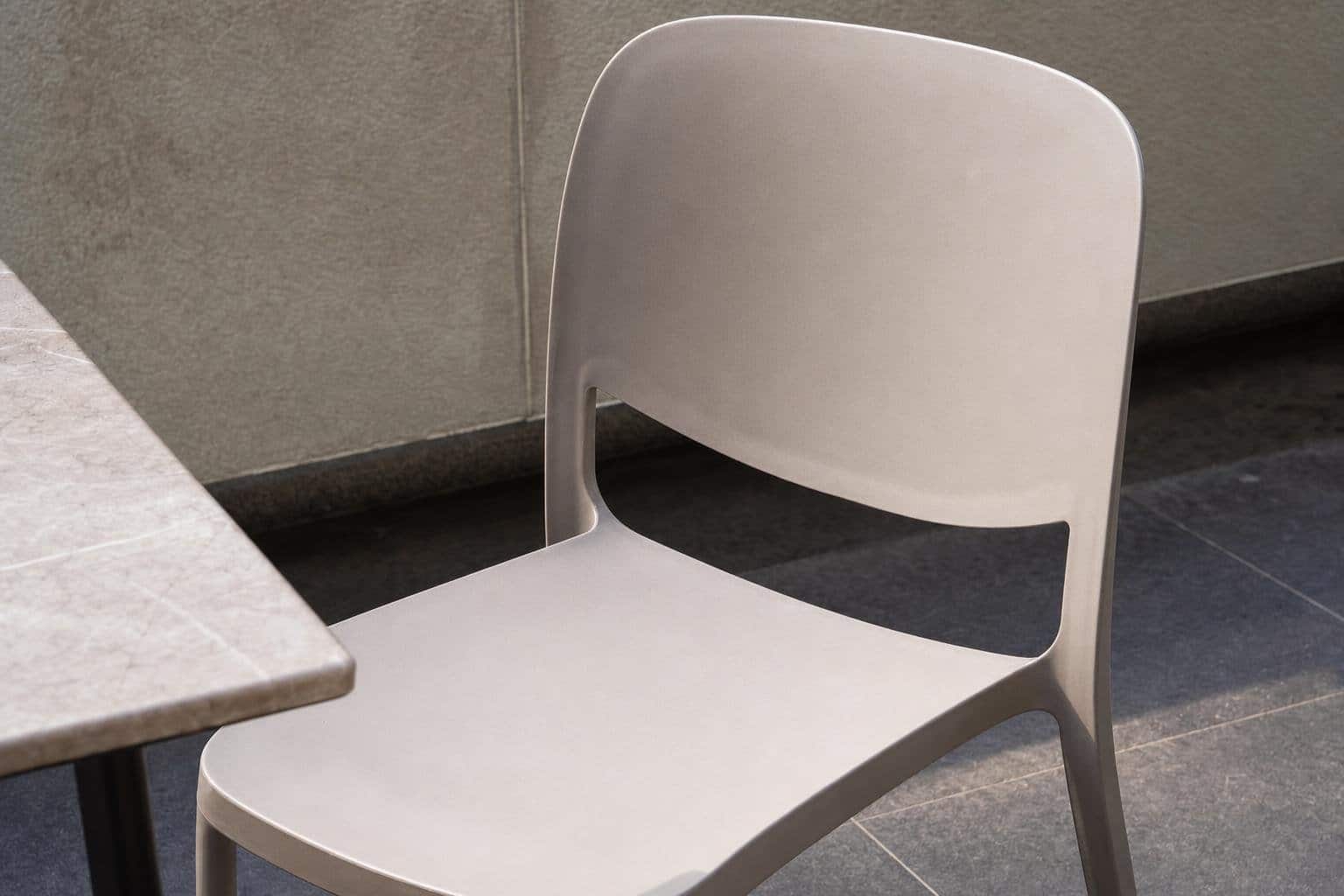
Before ordering, measure your actual table heights — do not rely on the nominal “standard.” If you are mixing new chairs with existing tables, confirm the numbers fit. The Armless Cafe Chair carries a verified seat height of 17 inches, which pairs well with tables in that conventional dining range. Counter-height tables (typically 34 to 36 inches) require a taller stool, not a dining chair; browsing the full catalog can help you match the right product to the right table format.
Also consider the horizontal clearance between chair arms and table aprons. Armless chairs solve this problem entirely — they slide under virtually any apron depth and allow guests to approach from any angle, which can meaningfully improve turnover at tight tables.
Hardware Longevity in a Commercial Context
Inspect the fastener specification and the complete chair before making a commercial purchase. Ask how connections should be checked and maintained, and how to obtain help if a chair becomes loose or damaged. Do not assume another model’s failure rate or corrosion performance from its price or appearance.
The Armless Cafe Chair uses the confirmed 3/16-inch stainless steel hardware. When comparing any chair, check the stated fastener specification, care instructions, and written terms rather than assuming performance from the frame material alone.
Also consider whether replacement hardware is readily sourced. In a commercial setting, a chair that can be re-tightened or re-fastened with standard hardware-store components is far more cost-effective to maintain than one requiring proprietary parts.

Outdoor Restaurant Chair Buying Checklist: Storage and Space Planning
Commercial operators often need to move seating — for private events, seasonal closures, cleaning days, or reconfiguring the floor plan. How a chair stores when not in service affects how much space you need and how much labor moving chairs requires.
Stackable chairs are a common solution in high-volume venues because they reduce the floor footprint significantly. Not all outdoor chairs are designed for stacking, and confirming that the manufacturer explicitly supports it is important before assuming you can stack a given model. Plastic Furniture To Go has not provided a verified stackability specification for the Armless Cafe Chair. If stacking is a firm requirement, confirm it directly instead of inferring it from the chair’s shape.
For operators with stable layouts, a chair that does not need to stack can still be practical, but stackability alone does not prove anything about silhouette or joint durability. Compare the exact construction and storage needs. Know your space constraints before you prioritize stacking.
Replacement Planning and Warranty Coverage
Commercial use is harder on furniture than residential use. A chair that sees one or two users a day at home might see fifty seatings a day on a busy patio. That reality means you should think about replacement planning before your first order arrives, not after chairs start showing wear.
A few questions worth asking: Does the manufacturer sell individual units so you can replace damaged chairs without buying full sets? How long is the warranty, and what does it actually cover? Plastic Furniture To Go publishes a 7-year structural warranty and a 5-year fading warranty. Before placing a restaurant or other commercial order, review the current warranty terms and confirm whether the intended use is eligible; do not assume residential and commercial coverage are identical.
Fading coverage is worth reviewing for outdoor commercial seating. PFTG publishes a five-year fading warranty; review its current terms and confirm whether the intended commercial use is eligible before ordering.
Accessibility and Guest Comfort Considerations
Guest comfort covers a range of factors: seat depth, back support, armrests or lack of them, and how easy the chair is to get in and out of. For commercial seating, you are not designing for one body type — you are designing for the full range of guests who will sit in those chairs across years of service.
Accessibility is a related and distinct consideration. Operators subject to ADA requirements should review the 2010 ADA Standards and confirm applicable rules with their local authority — furniture specifications are just one piece of a broader accessibility evaluation that includes table height, aisle width, and floor surface.
An armless chair may leave more lateral space in some accessible table configurations, but transfer needs vary. Follow the applicable accessibility requirements and evaluate the complete table-and-chair layout rather than treating one chair style as universally accessible. That said, some guests prefer the lateral support of armrests, so a mixed configuration often works well in larger venues.

Frequently Asked Questions
How does seat height affect table pairing for outdoor restaurant seating?
Seat height determines the vertical gap between the guest’s thighs and the underside of the table. Most dining tables sit 28 to 30 inches high, and a seat in the 17-to-19-inch range generally produces comfortable clearance. Always measure your actual tables rather than relying on nominal “standard” labels — small variations add up and affect guest comfort noticeably.
Is Marine Grade Polymer appropriate for high-use commercial environments?
Marine Grade Polymer is the published material specification for PFTG products. Confirm the complete chair, its hardware, care guidance, and warranty terms match your cleaning frequency and intended setting before a commercial order.
What should I understand about the return policy before placing a commercial order?
Returns are accepted within 30 days of receipt for products that are new, unused, unassembled, and in original packaging with proof of purchase. The customer is responsible for return packaging and freight unless the return is due to a seller error. Refunds exclude the original shipping cost. Review the full terms before placing a large order so expectations are clear.
How long does shipping take for commercial quantities?
Orders generally ship within 3 business days. Carrier transit is estimated at 2 to 7 business days after that, putting the typical customer delivery window at 5 to 10 business days. Shipping is free to the contiguous U.S. For large orders, it is worth confirming lead times directly with the seller, since commercial quantities may ship in multiple boxes or require scheduling for delivery.
Ready to work through the rest of your checklist with specific product questions? Contact Plastic Furniture To Go before you finalize your order — the team can confirm published specifications and point you to the current warranty terms so you can evaluate the configuration for your space. You can also view the Armless Cafe Chair with full specifications to see whether it fits your current table setup and seating plan.
Related guides: Stackable Plastic Patio Chair Benefits and Limits and Plastic Outdoor Dining Chair Fit-and-Finish Checklist.