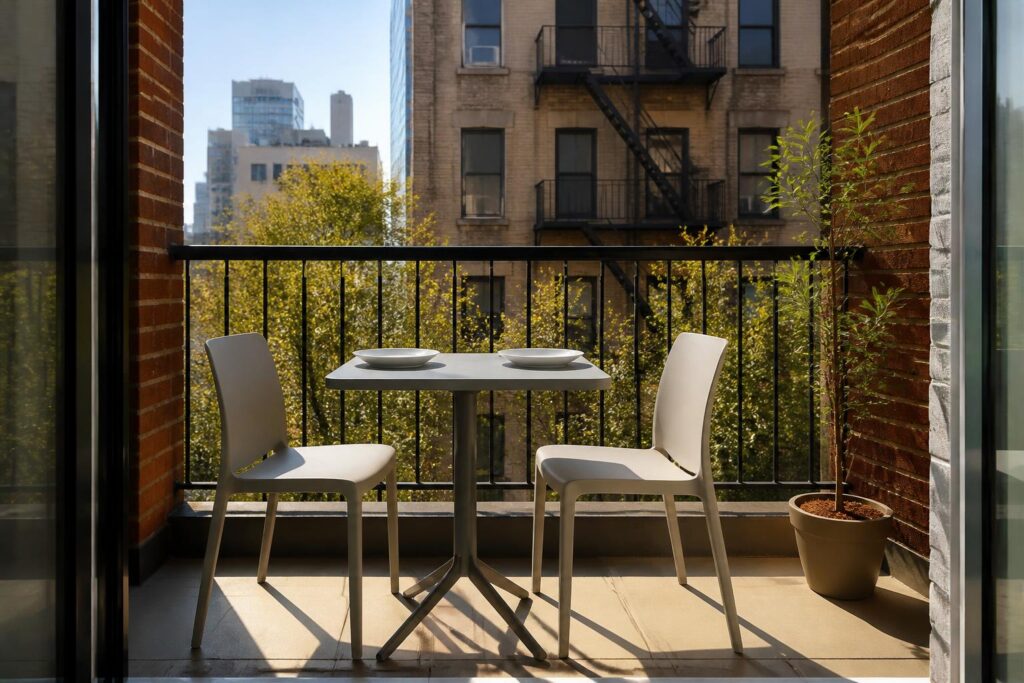
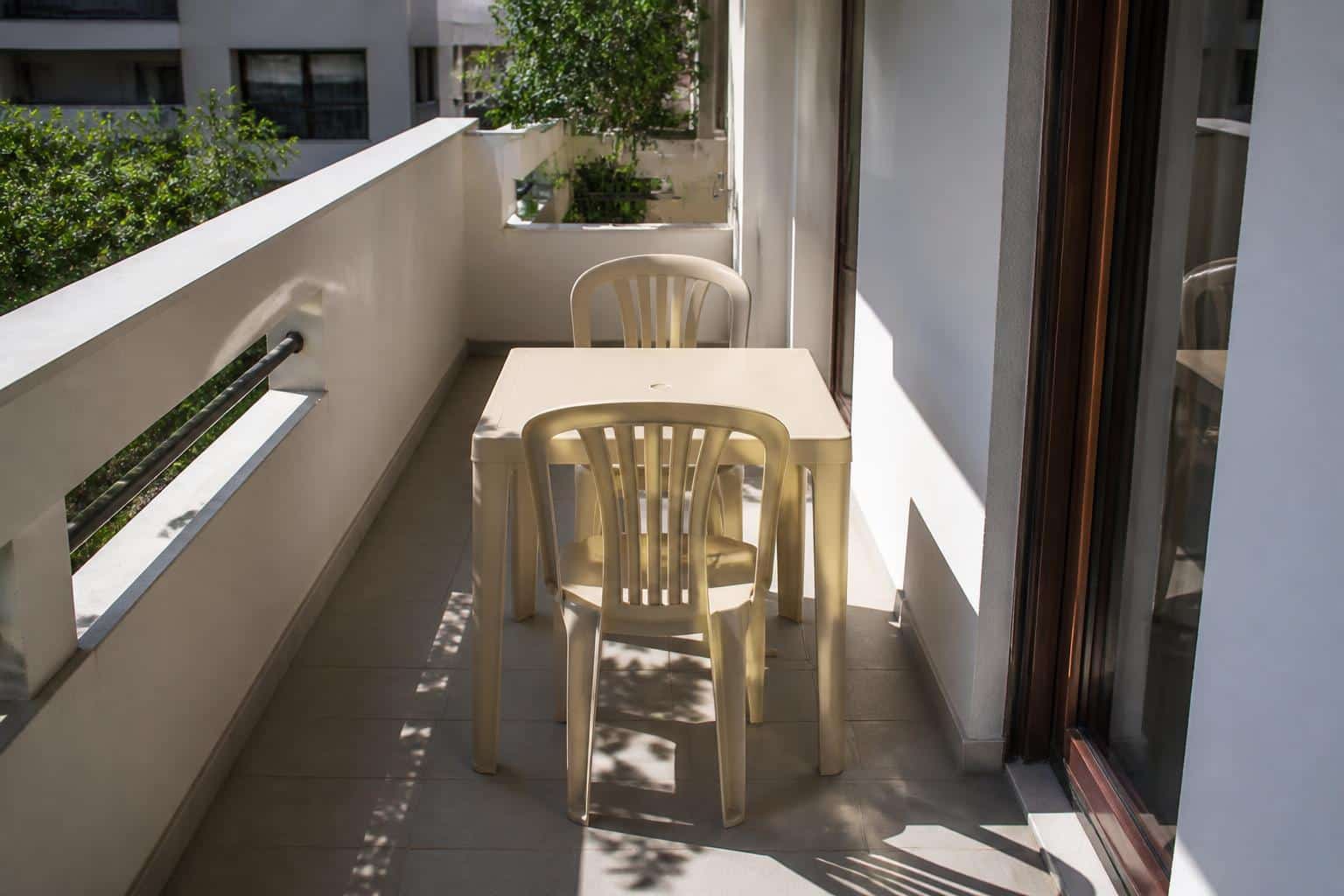
A compact patio dining setup asks more of every square foot than a full backyard layout ever does. On a balcony or a small deck, you’re negotiating door swings, railing heights, planter placement, and the simple question of whether you can actually pull a chair back without hitting something. The good news: with slim seating, the right table proportions, and a few clearance rules borrowed from interior designers, an outdoor space as small as 25 square feet can genuinely function for coffee, dinner, or a laptop hour outside. This guide walks through the measurements, furniture choices, and layout tricks that make small outdoor dining feel intentional rather than cramped.
Start With The Real Dimensions Of Your Space
Before you look at a single chair, get a tape measure and record five numbers: the depth of the deck or balcony from the building wall to the railing, the total width, the door swing arc (how far the door opens into the space), the railing height, and the distance from the floor to any obstruction like a light fixture or overhang. These five numbers tell you what a compact patio dining setup can honestly fit.
Most apartment balconies run between 4 and 6 feet deep and 6 to 12 feet wide. Small residential decks often land between 8 by 8 feet and 10 by 12 feet. Those sound modest, but subtract 30 inches for a dining chair pulled out and another 18 inches behind it for a person to stand, and suddenly a 5-foot-deep balcony has almost no room for a wide table.
Sketch the space on graph paper at a scale of one square per 6 inches. Draw the door swing as a quarter-circle arc so you can see the real usable floor. Mark where sun hits at mealtimes and where drainage slopes toward the edge. This 15-minute exercise saves you from ordering furniture that technically fits the footprint but blocks the door or leaves you climbing over a chair to reach the railing.
Choose Slim, Armless Seating That Tucks In
The single furniture decision that makes or breaks a small dining area is chair choice. Standard outdoor dining chairs run 22 to 26 inches wide with arms and need about 24 inches of side clearance per person. Armless chairs, by contrast, typically measure 17 to 19 inches wide and can share elbow space more gracefully. On a tight balcony, that difference decides whether two people can sit across from each other without their knees fighting for territory.
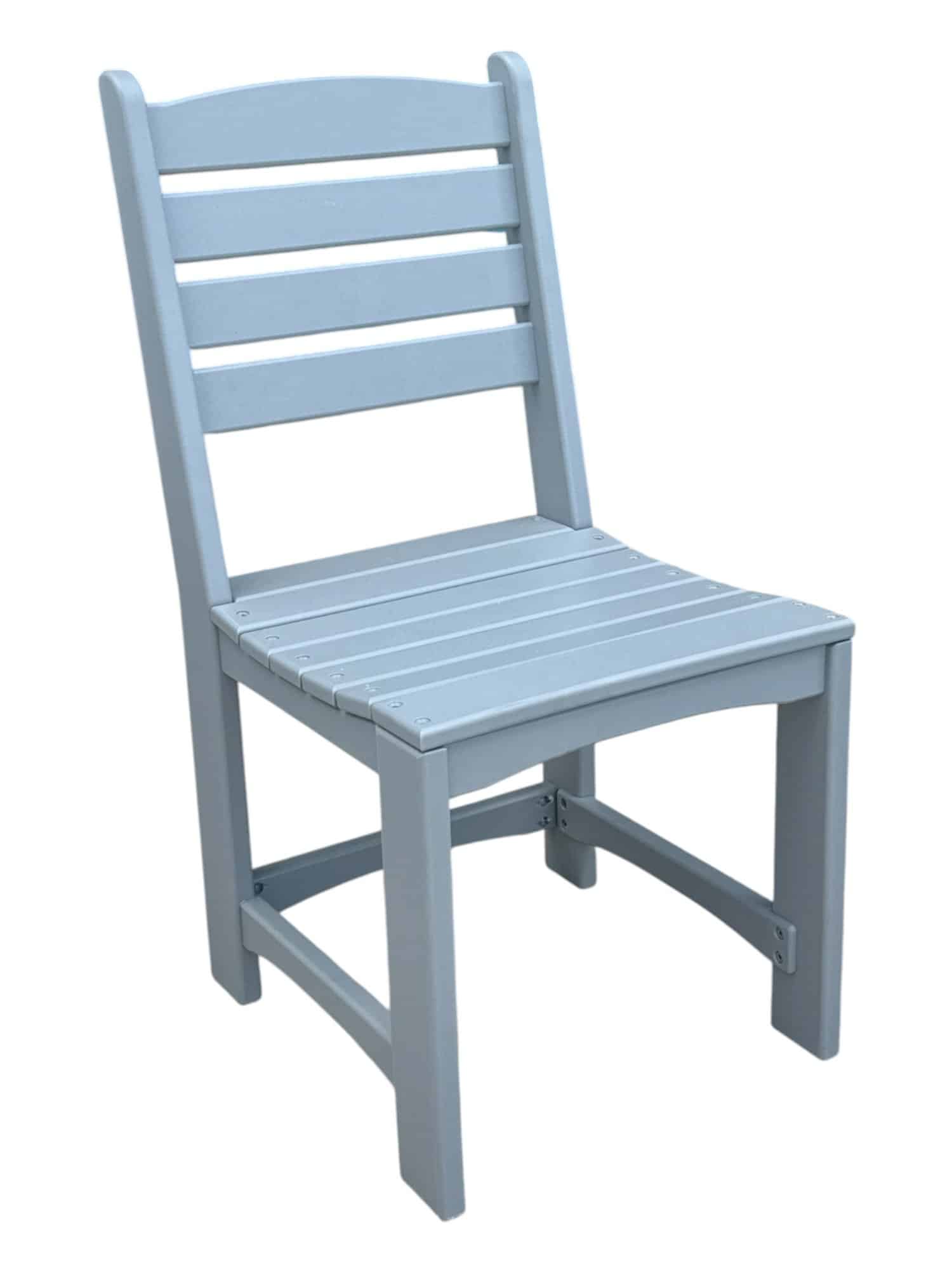
Compare the seat height with the underside of your table, and measure the space between its legs. Overall width determines side clearance; seat, arm, and frame dimensions determine how far the chair can tuck in. The Armless Café Chair measures 20.5 inches wide × 17.5 inches deep × 35 inches high, with a 17-inch seat height and a 27-lb weight. Check the actual fit rather than using back height as a rule. Follow balcony rules and plan storm storage for every loose piece.
An armless café chair is the natural fit for this use case because it slides completely under a bistro-height table when not in use, reclaiming floor space between meals. Two of them plus a small table often occupy less than 12 square feet in stowed position, which leaves room to walk out and enjoy the space without navigating an obstacle course.
What About Stools?
If your railing has a wide flat cap or you’re installing a fixed ledge along the wall, a counter-height stool can turn that surface into a dining bar. Counter stools generally have a 24- to 26-inch seat height and work with counters around 36 inches tall. This layout eats even less floor area than a table because the “table” is already mounted to the wall or railing.
Size The Table To The Space, Not The Other Way Around
Outdoor dining tables come in a wide range, but for compact patio dining setups the useful sizes are surprisingly small. A 24-inch round table seats two comfortably for coffee or a light meal. A 28- to 32-inch square or round handles two people for a full dinner with plates, glasses, and a small centerpiece. Anything larger than 36 inches starts crowding a balcony under 6 feet deep.
The clearance rule that matters most: leave at least 36 inches between the edge of the table and any wall or railing on the side where someone will sit. That 36 inches covers the chair depth (about 18 inches) plus room to slide the chair back and stand up (another 18 inches). If you can’t hit 36, you can compress to 30 inches with armless chairs and accept that standing up will be a slight shuffle rather than a graceful push-back.
Height matters too. Standard dining height is 28 to 30 inches. Bistro or counter height at 34 to 36 inches often works better on small balconies because taller tables visually clear the railing and let you see over it while seated. Pair a taller table with counter stools rather than dining chairs.
A pair of small end tables can also stand in for a dining table in the tightest spaces. Push two Hampton square end tables together for a shared surface at meals, then separate them along the railing between meals to serve as plant stands or drink perches. This modular approach fits balconies that need to shape-shift several times a day.
Layout Patterns That Work On Tight Footprints
Three arrangements handle almost every small-space scenario. The parallel-to-railing layout places the table long-side toward the railing with chairs facing each other perpendicular to it. This works on balconies that are wider than they are deep – typical urban high-rise balconies – and preserves the view from both seats.
The corner tuck puts the table in one corner with two chairs on the open sides. This is the layout for square-ish decks around 8 by 8 feet where you also want room for a grill or a planter cluster on the opposite corner. It centralizes the “living” zone and keeps circulation paths clear.
The rail-facing bar uses counter stools pulled up to a narrow ledge or rail-mounted shelf, so both diners face outward. This is the most space-efficient layout available – it can work on balconies as shallow as 4 feet – and it turns dinner into a view rather than a face-to-face conversation. Not every couple loves it as an every-night arrangement, but for one person eating breakfast with the paper, it’s ideal.
Whichever layout you choose, keep a clear path of at least 24 inches from the door to at least one chair. Fire safety guidance from the U.S. Consumer Product Safety Commission and general egress principles both point to keeping exit routes unobstructed – a rule worth honoring even on a private balcony. You can read general home safety guidance at cpsc.gov if you want the source material.
Materials And Weather For Exposed Small Spaces
Small balconies and decks tend to be more weather-exposed than ground-level patios. Upper-floor balconies catch more wind, more direct sun, and often more temperature swing because there’s no tree canopy or shrub buffering. Furniture choice needs to account for this.
Recycled plastic and HDPE (high-density polyethylene) furniture has become popular for exactly these conditions. As a material category, poly outdoor furniture resists UV fade, doesn’t absorb moisture, doesn’t rust, and generally handles temperatures from well below freezing to over 100°F without warping. It also tends to be heavier than aluminum, which helps on windy upper floors. When shopping, look for solid poly boards rather than hollow tubes, stainless-steel hardware, and UV inhibitors built into the material rather than applied as a surface coating.
Wood furniture works aesthetically but demands annual sealing on exposed balconies, and untreated wood can stain composite decking. Powder-coated aluminum is light and rustproof but can skid in wind and dent if dropped. Wicker-look resin is decorative but often uses a metal frame that can rust at joints once the resin cracks. Every material has a tradeoff – the right choice depends on how much maintenance you want to do and how exposed the space is.
Whatever material you pick, ask about warranty specifics. A clear structural warranty and a separate fade warranty are more informative than vague “long-lasting” language. Plastic Furniture To Go, for example, backs its outdoor pieces with a 7-year structural warranty and a 5-year fade warranty, which gives you a concrete benchmark to compare against other brands you might be considering.
Small Touches That Make A Balcony Feel Like A Room
Once the furniture fits, the finishing choices decide whether the space feels like a genuine outdoor room or a leftover corner. A weatherproof outdoor rug in a size that just fits under the table legs anchors the seating visually and softens hard deck surfaces. Aim for a rug that clears each table leg by at least 4 inches but doesn’t run all the way to the railing – leaving a border of deck visible makes the space feel larger.
Lighting extends the usable hours dramatically. Battery-operated LED lanterns, solar string lights along the railing, or a rechargeable table lamp all avoid the extension-cord hassle that plagues balconies without dedicated outlets. Warm color temperatures around 2700K feel more like a restaurant patio than the cool 4000K of a porch light.
Vertical planting is the small-space gardener’s trick: railing-mounted planters, a wall-hung herb pocket, or a single tall planter in the corner adds greenery without eating floor area. Herbs like rosemary, basil, and mint pull double duty because you can pinch them into whatever you’re eating at the table two feet away. Just verify with your building or HOA that railing-mounted planters are permitted, since some restrict any hardware attached to the outside of the railing.
Frequently Asked Questions
What’s the smallest balcony that can fit a real dining setup?
A balcony roughly 4 feet deep by 6 feet wide – about 24 square feet – can hold a rail-facing bar setup with two counter stools and a narrow shelf. For a proper face-to-face table for two with armless chairs, plan on at least 5 feet of depth and 6 feet of width. Below that, you can still enjoy morning coffee outside, but full dinners become a stretch of the space and the chairs.
How much weight can a typical balcony hold?
Residential balconies in the U.S. are generally engineered for 40 to 60 pounds per square foot of live load, but the actual capacity depends on your building’s construction, age, and any local code amendments. Two people plus furniture is not typically a concern, but heavy planters, a hot tub, or a crowd at a party can push limits. If you’re unsure, check with your building manager or a licensed structural inspector before adding heavy pieces.
Do I need to bring outdoor furniture inside during winter?
Quality poly and HDPE furniture is designed to stay outdoors year-round through freezing temperatures without cracking or absorbing moisture. Cushions and pillows should come inside or into a waterproof deck box because fabric holds moisture and can mildew. On very windy upper-floor balconies, some people bring lighter pieces inside during major storms simply to prevent them from moving, not because the material would be damaged.
Can I leave chairs stacked on a balcony?
Stacking works if the chairs are designed for it and the stack is secured against wind. Look for chairs with stacking notches or flat seat pans that align cleanly. On upper-floor balconies, avoid stacking more than three high, and never leave a stack unsecured during forecast wind events – a chair falling from height is a serious hazard. A bungee cord looped through the stack and around a railing post is a simple, effective solution.
If your small outdoor space has a counter instead of a dining table, check the Counter Height Stool dimensions against the counter before ordering.
A well-planned compact patio dining setup delivers something bigger than the square footage suggests: a real place to eat, work, or unwind outside without leaving home. Plastic Furniture To Go builds slim café chairs, small end tables, and counter stools that are made in America, sold factory-direct with free nationwide shipping, and sized for exactly this kind of space. Browse the full lineup on the armless café chair page to see dimensions and color options, and reach out through the contact page if you’d like a second opinion on what will fit your balcony before you order.