
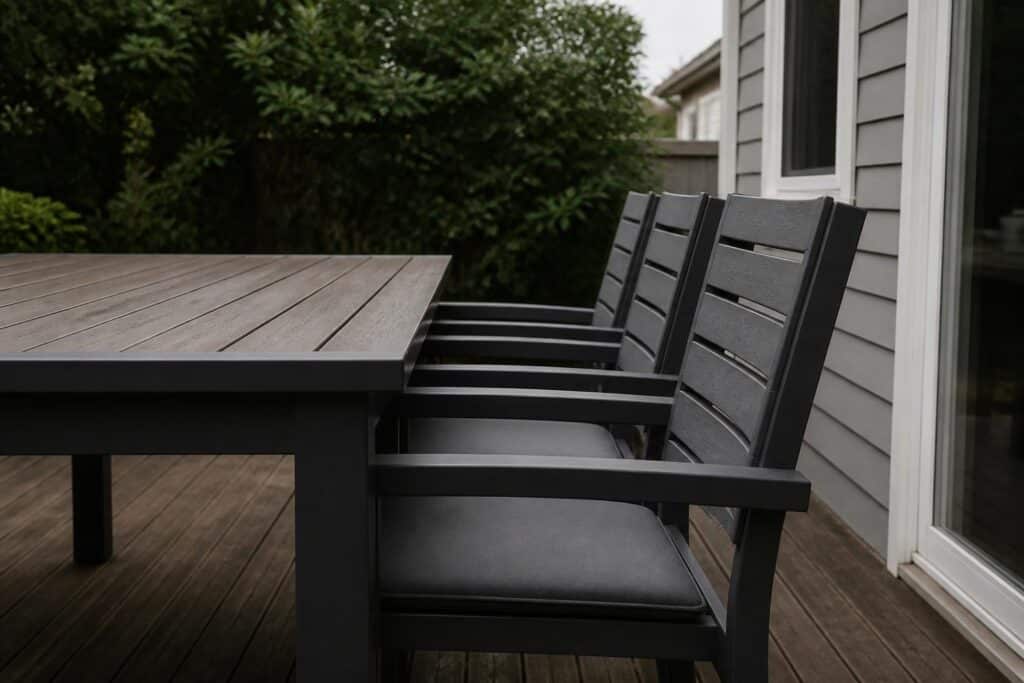
Buying outdoor dining furniture gets easier once you understand patio chair arm height table clearance. A chair can look perfect in a product photo and still frustrate you every day if the arms hit the table or the seat sits too far forward to tuck in neatly.
The good news is that you do not need complicated math. A few simple measurements will tell you whether a chair will slide under the table, how much room people need to sit comfortably, and when an armless option is the better fit.
Start with the two measurements that decide everything

The first number to check is chair arm height. Measure from the ground to the top of the arm at its highest point. The second number is the open height under the table, measured from the ground to the lowest obstruction beneath the tabletop. That obstruction may be the table apron, support frame, or the underside of the top itself.
For a chair with arms to tuck under a table, the chair arm height must be lower than the table’s clear opening. You also want a little extra room so the chair does not scrape every time someone sits down. Even a chair that technically fits can feel annoying if the clearance is too tight.
This is where shoppers often get tripped up. They measure only the tabletop height, but tabletop height alone does not tell you the usable opening. If the table has a thick apron or support rail, the actual clearance can be several inches lower than expected.
Before you buy, measure:
chair arm height
seat height
distance from front of chair to back of arm
table height
underside clearance at the apron or support frame
distance between table legs if relevant
Once you have those basics, the rest of the decision becomes much clearer.
Arm height is important, but apron depth often causes the real problem
Many people assume the arms are the only issue. In practice, the table apron is often what blocks a chair from sliding in fully. A deep apron reduces the vertical space under the table and can stop the chair before it reaches a comfortable seating position.
If the arm clears but the chair still does not tuck in, look at where the arm meets the table edge and whether the seat frame or upper back runs into the apron. Some chair designs rise quickly behind the arms, which means the chair may contact the table underneath even if the arm itself fits.
That is why you should think about the chair moving through space, not just touching one point. A chair does not teleport under a table. It travels inward at a slight angle, and every part of it needs enough room during that motion.
For compact dining spaces, armless chairs avoid that pinch point altogether. An Armless Cafe Chair can be easier to pair with a wider range of outdoor dining tables because there are no arms competing with the underside clearance. That can be especially useful if your table has a pronounced apron or a pedestal base that already limits knee room.
Seat position changes how close someone can sit to the table
Clearance is not just about whether the chair fits under the table. It is also about whether the person using it can sit close enough to dine comfortably. That depends on seat position.
Look at where the front edge of the seat lands in relation to the table edge when the chair is tucked in. If the arms or frame stop the chair early, the sitter may end up too far from the tabletop. That can make meals feel awkward, especially on smaller tables where every inch counts.
Seat position also affects how much of the chair stays exposed when pushed in. If a chair only goes halfway under the table, the dining area may feel tighter and less organized. In a narrow patio or deck layout, that visual bulk can matter almost as much as the physical fit.
Armed dining chairs can still work very well, but they benefit from a table designed with enough open space below. If your priority is maximum tuck-in ability, armless seating usually gives you more flexibility. If your priority is lounge-like support at a dining table, then chair arms may still be worth it as long as you confirm the measurements first.
Pull-back room deserves as much attention as tuck-in clearance
A chair can fit under a table perfectly and still feel cramped if there is not enough room to pull it back. People need space to enter and exit without bumping a wall, railing, planter, or another chair.
Think of your dining setup in two positions: pushed in and actively used. Pushed in, the table should feel tidy and efficient. In use, each chair should be able to slide back enough for someone to sit down naturally.
This is especially important with heavier outdoor furniture. Weight can be a positive because it adds a substantial, stable feel, but you still want enough open floor area so chairs are easy to move. Confirmed product weights from Plastic Furniture To Go include the Hampton Adirondack Chair at 52 lb, the Armless Cafe Chair at 27 lb, the Counter Height Stool at 21 lb, and Hampton round and square end tables at 15 lb each. Those numbers are helpful because they give you a realistic sense of how pieces may handle in everyday use.
If you are planning a dining area, map out the pull-back path behind each chair. Check for grill islands, exterior doors, and traffic lanes. If the chair can tuck in but cannot pull back comfortably, the layout still needs adjustment.
For general circulation planning, the ADA accessible route guidance is a useful reference for understanding clear paths and movement space around furniture.
Table base style can limit chair placement more than expected

Not all clearance problems happen at the table edge. Sometimes the real obstacle is below the center of the table. Pedestal bases, cross supports, and leg stretchers can interfere with where feet and chair legs want to go.
With a four-leg table, measure the distance between the legs on every side where chairs will sit. This tells you whether the chair can center properly without bumping a leg. With a pedestal table, check how wide the pedestal footprint is and how close it sits to normal foot placement.
If chairs have arms, also consider whether users will naturally angle the chair when they sit down. Angled entry takes up more width than a straight push-in. That can matter on tighter balconies, smaller patios, and apartment terraces where every chair movement has to be efficient.
Another overlooked detail is the relationship between the chair back and the tabletop overhang. Some chairs need a little extra horizontal room before they can align under the table. If the back shape flares or the upper frame projects outward, the chair may stop sooner than you expect.
In short, measure the whole seating zone, not just the apron height.
How material and construction affect day-to-day use
Fit is the first goal, but construction quality shapes how the setup performs over time. Outdoor dining furniture gets dragged, pushed in, pulled out, and exposed to changing weather. That is why durable materials and hardware matter in a practical clearance conversation.
Plastic Furniture To Go builds American Made outdoor furniture in Marine Grade Polymer with 3/16-inch stainless steel hardware. For buyers comparing long-term value, that combination supports everyday outdoor use without turning this into a high-maintenance furniture category.
The brand also offers free shipping to the contiguous U.S., a 7-year structural warranty, and a 5-year fade warranty. Those details matter when you are ordering online and want confidence that the furniture is built for regular use in real outdoor spaces.
Material choice also influences how a chair slides near table edges and how consistent the fit feels over time. Well-made outdoor dining furniture should feel solid and dependable, especially in seating areas that get used often for meals, morning coffee, or casual entertaining.
When an armless chair is the better solution
If you already own a table and the under-table opening is tight, an armless chair is often the simplest answer. It removes the most common conflict point and usually gives you more freedom with seat placement.
Armless chairs can also make a smaller patio look cleaner because they tuck in with less visual interruption. The dining area may feel more open, and guests often find it easier to move in and out when there are no arms to navigate around.
That does not mean arms are a bad choice. Chairs with arms can feel more relaxed and supportive, especially for longer meals. The key is matching the chair profile to the table’s usable opening, not just the listed table height.
If you are building a new outdoor setup from scratch, compare chair style and table clearance at the same time instead of choosing them separately. That small planning step can prevent a very common outdoor dining mistake.
A simple measuring method before you place an order
Use this quick process before you buy:
1. Measure the table from the ground to the lowest point underneath.
2. Measure the chair arm height if the chair has arms.
3. Check for apron depth or support rails that reduce usable space.
4. Measure how far the seat and upper frame project forward under the table.
5. Confirm the width between table legs or around the pedestal base.
6. Leave enough room behind the chair for comfortable pull-back and walking space.
If your space is compact, use tape on the ground to mark the chair footprint in both the pushed-in and pulled-out positions. That simple test gives you a much better sense of real-world fit than reading dimensions in isolation.
It is also smart to think about who will use the space most. A family dining area, a balcony breakfast setup, and a poolside café arrangement may all need different levels of tuck-in efficiency and circulation room.
Frequently Asked Questions
How much clearance should there be between chair arms and the table?
The chair arms should be lower than the table’s actual open height underneath, not just the tabletop height. A little extra room helps the chair slide in without scraping.
Can a chair fit under a table if the arms clear?
Not always. The apron depth, support frame, seat position, and chair back shape can still stop the chair before it tucks in fully.
Are armless patio chairs better for small outdoor dining areas?
Often, yes. Armless chairs usually work with more table styles, tuck in more easily, and can make a compact space feel less crowded.
What should I measure besides table height?
Measure underside clearance, apron depth, width between table legs, chair arm height, and the room behind the chair for pull-back space.
Ready to compare outdoor seating that works with your dining layout? Shop the collection or Contact us online for help choosing the best fit for your space.
Keep planning with these guides: How to Read Outdoor Furniture Dimensions Online, Armless Dining Chairs: The Small-Patio Space Saver, and Austin Balcony and Small-Yard Furniture Layouts.

