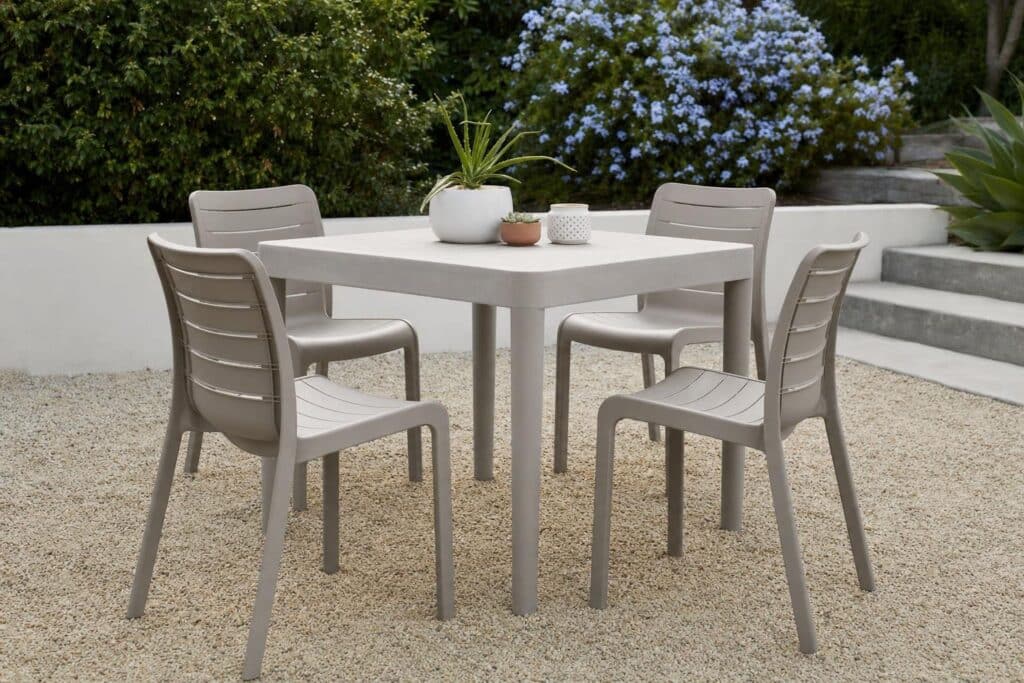

Choosing between round vs square outdoor end tables sounds like a small decision until you’re standing on your patio with a tape measure, trying to figure out whether a corner table will actually work between two chairs or block the path to the grill. Shape changes how a table fits, how easily you can reach a drink, and how the whole seating group flows. This guide walks you through the practical differences: footprint, reach, corner behavior, walkway clearance, styling, and safety around kids and pets. By the end you’ll know which shape suits your layout and which one earns its keep.
How Shape Changes the Way an End Table Behaves
An end table has one job: put a surface within arm’s reach so you can set down a drink, a book, or a phone without twisting or getting up. Both round and square tables can do that, but the way they occupy space is different in ways you feel every time you use the patio.
A square end table gives you more usable surface area for the same nominal size. A 20-inch square top offers 400 square inches of surface. A 20-inch round top offers about 314 square inches – roughly 22 percent less. That matters when you want to fit a lamp, a drink, and a snack plate together, or when someone sets down a laptop while working outside.
Round tables win on flow. With no corners, you can brush past them without catching a hip or scraping a shin. That makes a real difference in a tight seating group where people rotate in and out. Round tables also read as softer visually, which tends to calm down a busy patio full of rectangular chairs, planters, and pavers.
Square tables align with linear furniture – sofas, benches, and chairs with straight arms. Their edges continue the line of the chair arm, which gives the seating group a tailored, deliberate look. Round tables break that line on purpose, which is either a welcome contrast or a mismatch depending on the rest of your setup.
Measuring Your Space Before You Choose
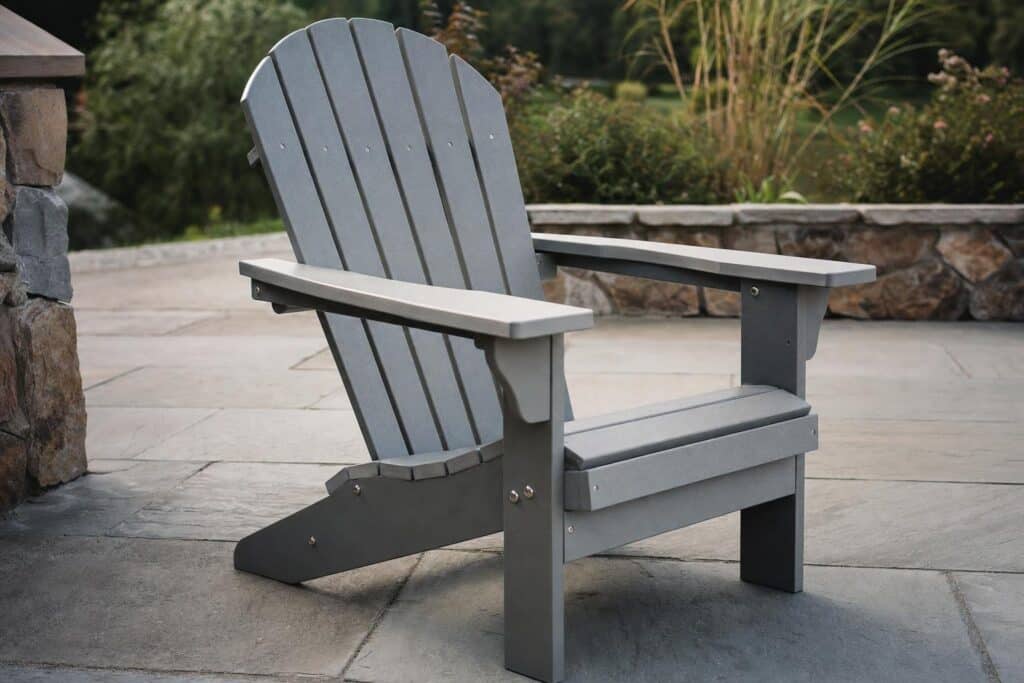
Before shape, get the numbers. Most outdoor end tables land between 18 and 22 inches wide and 18 to 24 inches tall. The height should sit within two inches of your chair arm – too far below and you’re reaching down awkwardly, too far above and drinks feel perched. For a standard Adirondack with an arm around 24 to 26 inches off the ground, a 20 to 22-inch-tall end table is the sweet spot.
Walkway clearance is where most patios go wrong. A comfortable primary walking path wants 36 inches of clear space. A secondary path where one person passes at a time can drop to 24 inches, but no lower if you want to walk through carrying two plates. Measure the tightest pinch point between the future table and whatever it’s near – a planter, a railing, a grill.
Between two chairs, an end table typically sits with 2 to 4 inches of gap on each side of the chair arm. That’s close enough to reach a drink without leaning, far enough that arms don’t scrape the table when you sit down. If you plan to put a chair on each side of a single table, aim for the table to be roughly the same width as – or slightly wider than – the chair arm-to-arm gap.
Also measure vertical clearance if the table sits under a low pergola beam, umbrella rib, or hanging light. You want a hand and a glass to swing freely above the tabletop.
When a Round End Table Is the Better Choice
Round tables shine in three situations. First, tight seating groups where people move around often. The absence of corners means fewer bruised shins and less snagged clothing. If your patio hosts kids running laps or a dog that patrols the perimeter, a round profile is genuinely kinder.
Second, curved or organic layouts. If your seating arcs around a fire feature, faces a curved pool edge, or wraps a rounded deck, a round table continues that geometry. Placing a square table in a curved arrangement can look accidental, like a puzzle piece from the wrong box.
Third, mixing with heavier chairs. Adirondack chairs, with their fanned backs and wide arms, already carry a lot of visual weight and angles. A round end table gives the eye a place to rest. Many people pair a round table with two Adirondacks specifically for that softening effect. The Hampton Round End Table is sized to sit comfortably between two loungers without dominating the group.
Round tables also handle uneven placement better. If the table gets shifted six inches to the left during a get-together, a round shape rotates without looking off-axis. A square table shows every degree of rotation and needs to be squared back up.
The tradeoff: less usable surface area, and no natural corner to tuck against a wall or railing. Push a round table against a straight wall and you’ll always have a small crescent gap behind it where leaves and drink rings collect.

When a Square End Table Is the Better Choice
Square tables are the workhorses of most patios. They tuck neatly into the inside corner of an L-shaped sectional, sit flush against a wall or railing, and align with the edges of rectangular chairs. If your seating is arranged along straight lines – a pair of chairs facing a rectangular fire pit, a sectional against the house, chairs flanking a doorway – square is the natural choice.
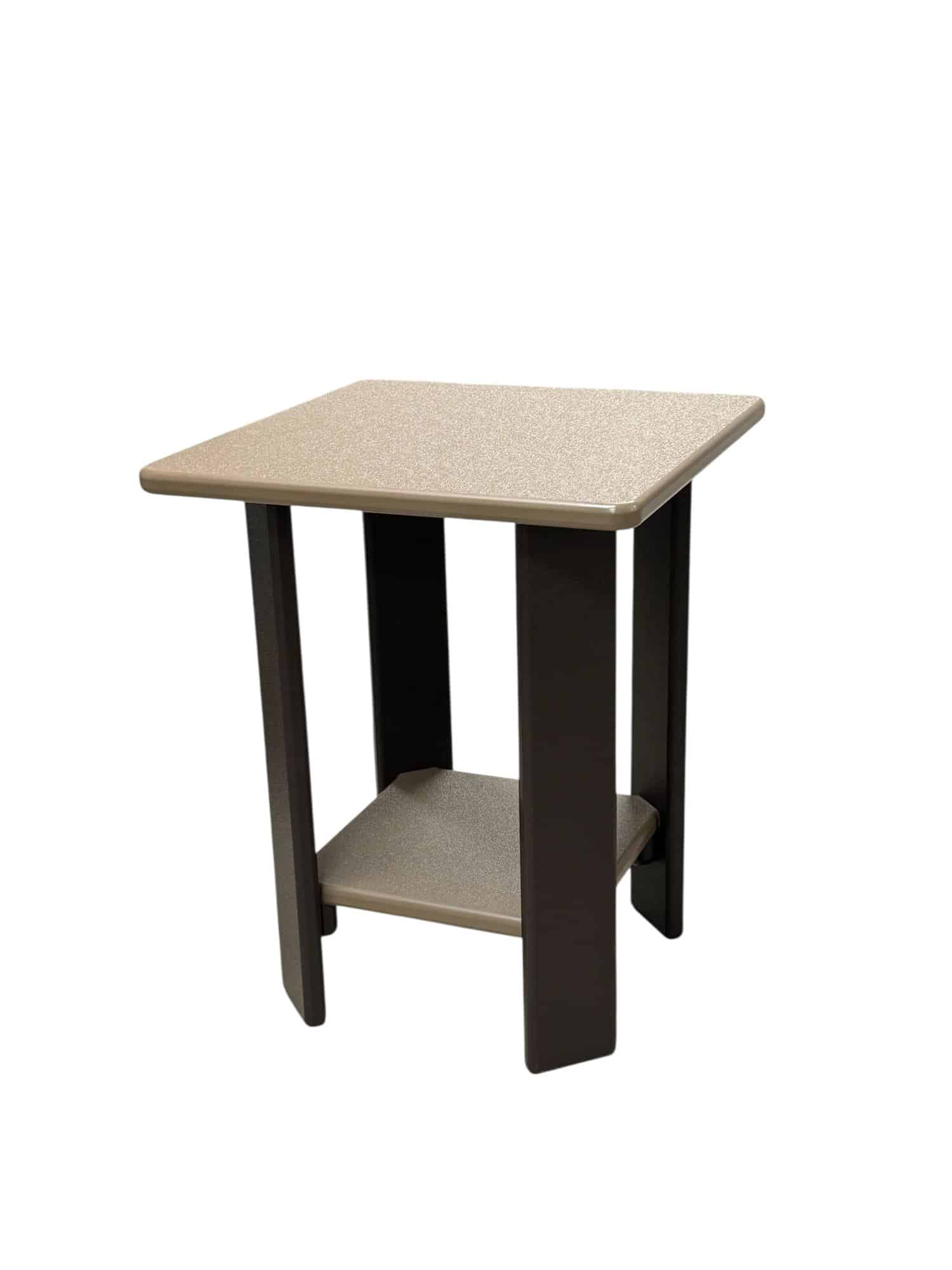
A square tabletop provides corners that may suit the items you want to set down. Compare the actual tabletop dimensions with your lamp base, book, or tray and keep loads within the manufacturer’s intended use. The Hampton Square End Table offers a 15-inch × 15-inch top; its shape is a layout choice, not a guarantee against wobble.
Square tables also pair well when you want two end tables to read as a matched set flanking a sofa or bench. Two squares on either side of a three-seat sofa look intentional and symmetrical. Two rounds in the same position can feel a little floaty, like they’re waiting to drift away.
Corner Fit and Wall Placement
If your table will live against a wall, in a corner, or wedged between two pieces of furniture, square wins every time. The 90-degree corners align with everything around them, so the table uses every inch of the space you give it.
Traffic and Kids
The tradeoff is those same corners. In a walkway or a busy family patio, square edges catch hips and knees. Some poly square tables have slightly softened corners – a small radius on each edge – which helps without giving up the square footprint. If you have young kids or move around the patio often, check the corner detail before committing.
Material and Weather Considerations for Any Shape
Shape and material answer different questions. Compare the exact table’s material, finish, hardware, care guidance, and written coverage. Do not assume that a generic poly or HDPE label establishes color-through construction, a fading rate, or a particular service life.
Use actual product weight for handling and storage planning. Weight does not identify hollow or solid construction and is not a wind rating. Ask the seller for construction details and any tested limits that matter for your use. The EPA recycling overview provides general background rather than proof of a particular table’s composition.
PFTG’s tables carry seven-year structural and five-year fading coverage under the written policy. Compare covered issues, exclusions, and the claim process instead of treating the periods as lifespan forecasts. The returns and warranty page contains the full terms.
Read the care and seasonal-storage instructions for each table. Rain, sun, salt, hardware condition, and severe weather all belong in the plan. Check sun-exposed surfaces before use and provide shade where practical. No material label or finish color guarantees a comfortable surface temperature or freedom from damage.
Styling Your End Table with the Rest of the Patio
Match shape to the dominant lines of your space. If you already have a round dining table or a circular fire pit, echo that with a round end table. If your patio is defined by rectangular pavers, straight railings, and boxy chairs, square continues the vocabulary.
Color is where you can be bolder outdoors than you might indoors. Poly tables come in a range that includes classic whites and blacks, driftwood grays, warm sand, and saturated blues, greens, and reds. A neutral chair with a colored end table gives you a pop that’s easy to change later if you swap the chair.
Height matching matters more than shape matching when you mix pieces. Two end tables at the same height flanking a sofa look right whether they’re both round, both square, or one of each. Two tables at different heights look wrong no matter how they’re styled.
Finally, think about what lives on top. A lantern, a small potted succulent, or a stack of two coasters is enough. Outdoor end tables photograph better with negative space than with clutter, and in real life you want room to actually set your drink down.
Frequently Asked Questions
Can I mix a round end table with a square coffee table?
Yes, and it often looks better than matching. A round end table paired with a square or rectangular coffee table gives the seating group visual variety while keeping the pieces related through material, color, and height. The trick is consistency in finish – if the coffee table is a driftwood-gray poly, the end table should be the same color family. Mixing shapes with matching finishes reads as intentional design.
What size end table fits between two Adirondack chairs?
Aim for an end table roughly 18 to 22 inches wide and 20 to 24 inches tall. Adirondack chairs sit lower than standard patio chairs, so a shorter table keeps the arm-to-tabletop transition natural. Leave 2 to 4 inches between the chair arm and the table edge on each side. Both Hampton end tables at 19 inches wide fit this pairing comfortably without crowding the chair arms or forcing an awkward reach.
Do square end tables tip over more easily than round ones?
Use either table on a suitable level surface and follow its intended-use instructions. Do not infer a safe load or wind rating from the shape or weight. Check that all feet are supported, avoid unstable placement or overhanging loads, and stop using a damaged or wobbly table until the problem is addressed.
How do I clean poly end tables after a full season?
Follow the care instructions for the exact product and finish. Ask the seller about an unfamiliar cleaner or stain, and test any approved method in a small inconspicuous area before wider use. Follow cleaner labels and do not mix cleaning products.
Round vs square outdoor end tables really comes down to how your patio moves and what shape your existing furniture already speaks. Plastic Furniture To Go builds both the Hampton Round and Hampton Square at $119, American made and factory-direct with free nationwide shipping, so you can pick shape based on your layout rather than your budget. Browse the full Hampton Square End Table and Hampton Round End Table pages to see colors and dimensions, and reach out through the contact page if you’d like a second opinion on which shape fits your setup.