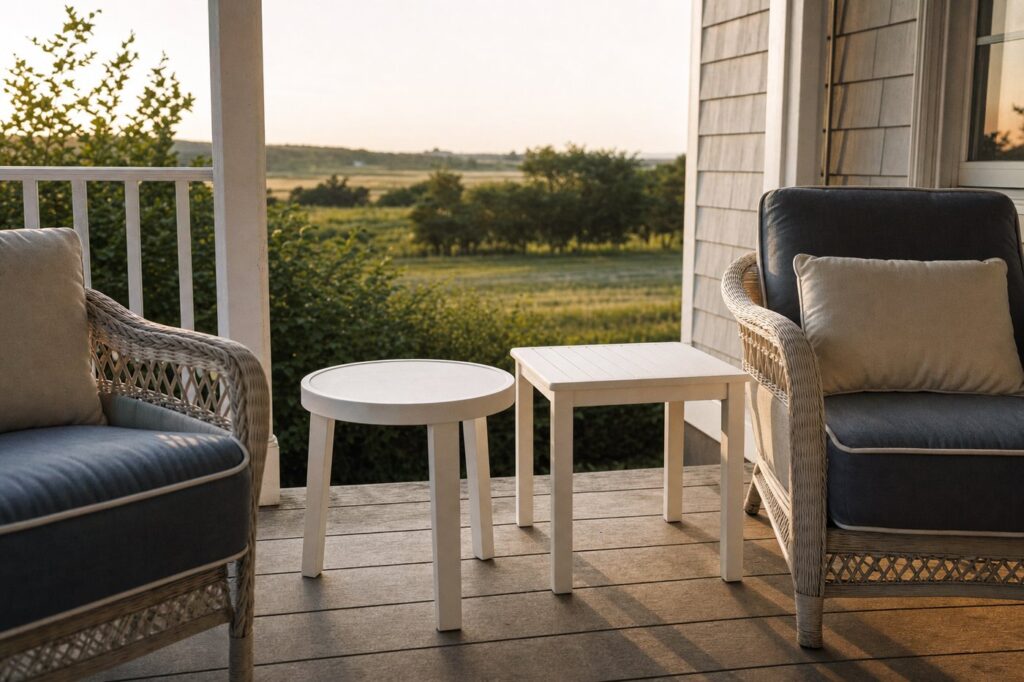
An end table seems like the smallest decision in outdoor furniture shopping, right up until you’re standing in your own patio trying to picture where it will actually go. Round or square isn’t just a style preference — it changes how the table fits into tight spaces, how it feels next to your seating, and how safe it is around high-traffic areas. Here’s how to think through the choice using our Hampton Round End Table and Hampton Square End Table as the comparison.
Both Tables Share the Same Foundation
Both Hampton end tables use Marine Grade Polymer and 3/16-inch stainless steel hardware, weigh 15 lb, and are American Made. Both carry seven-year structural and five-year fading coverage under the same written policy. Compare the actual tabletop shape and dimensions with your layout; these shared facts do not establish identical performance or lifespan.
The Published Sizes, Side by Side
The Hampton Round End Table has a 17-inch round top and stands 18.5 inches high. The Hampton Square End Table has a 15-inch by 15-inch top and is also 18.5 inches high. Both are $119. Because the heights match, the choice comes down to footprint and how each shape behaves in your layout, not how the table sits against a chair arm.
A simple calculation shows how close the two are: a 17-inch round top covers roughly 227 square inches, and a 15-inch square top covers 225. The shapes differ in how that surface is arranged, not in how much of it you get. The square puts usable area in its corners, while the round table’s widest reach is a 17-inch span across its center.
Round Tables: Better for Tight or High-Traffic Spaces
A round table has no corners, which matters more than it might seem. In a smaller patio, a narrow side yard, or a spot near a walkway, a round table lets people pass closer to it without catching a hip or shin on a sharp edge. That makes it a practical choice near pool decks, on narrow balconies, or anywhere kids or pets move through the space quickly.
Round tables also tolerate imperfect placement. If a guest nudges the table a few inches during a get-together, a round top rotates without looking off-axis, while a square top shows every degree of rotation and needs to be squared back up. The trade-off is that a round table pushed against a straight wall leaves a small crescent gap behind it where leaves and drink rings collect.
Round tables also tend to read as softer and more casual, which pairs well with curved seating like an Adirondack chair or a rounded lounge chair, echoing the table’s own shape.
Square Tables: Better for Corners and Structured Layouts
A square table fits flush against a straight-backed sofa, a wall, or the arm of a sectional in a way a round table can’t. If you’re setting up a matched, symmetrical outdoor living area — say, a sofa and two chairs around a coffee table, with end tables bookending the sofa — the straight edges of a square table line up cleanly with straight furniture edges and keep the whole layout looking intentional rather than scattered.
A square top also gives you real corners to work with, which can matter if you’re setting a lamp, a book, and a phone on the table at once. Compare the tabletop dimensions with the items you actually use, and keep loads within the table’s intended use. The trade-off is those same corners: in a walkway or a busy family patio, square edges catch hips and knees, so think twice about a square table beside a path that children or pets use.
Think About What Sits Next to It
The chair or sofa beside the table matters as much as the table itself. Pair a round table with rounded seating and the whole grouping feels cohesive. Pair a square table with structured, straight-lined furniture and the same thing happens in a more architectural way. Mixing shapes isn’t wrong, but if you want a pulled-together look rather than an eclectic one, matching the table’s shape to your seating’s lines is the simplest way to get there.
Measuring Before You Buy

Whichever shape you choose, measure the actual gap where the table will sit, not just the general area. Leave enough space on at least one side for someone to reach a drink or set something down without bumping a neighboring chair. Plan for a clear walking path of about 36 inches where people pass regularly, and at least 24 inches where one person passes at a time; measure the tightest pinch point between the future table and a planter, railing, or grill. Also allow a few inches between the table edge and the arm of each neighboring chair so arms do not scrape it when someone sits down, and check vertical clearance if the table will sit under a pergola beam, umbrella rib, or hanging light.
Include the objects you actually use in the layout test. Place your usual tray, book, or unbreakable cup on a cardboard outline of the proposed tabletop while the outline rests on an existing supported surface. Check the arrangement from the seated position instead of standing over it. Keep everyday items within a comfortable reach and away from the edge. The useful comparison is whether each model accommodates your routine, rather than whether one shape looks larger in a photograph.
Durability Outdoors, Either Shape
Follow the care and seasonal-storage guidance for each table. Rain, sun, hardware condition, surface support, and severe weather all matter. Neither material nor tabletop shape guarantees that a piece cannot be damaged or removes the need for a storage plan.
The shared hardware specification is a fact to record alongside dimensions and written coverage. It does not prove that the two models will perform identically or last the same number of years. Choose by fit and intended use, and inspect each table’s condition during ownership.
Using Two Tables Together
Some outdoor layouts benefit from one of each shape rather than choosing a single style for the whole space. A round table beside a curved lounge chair on one side of a seating area, paired with a square table anchoring a straighter sofa arrangement on the other, can look intentional rather than mismatched, especially if both tables share the same color and material finish. The consistency of the material carries the look even when the shapes differ.
If you’re furnishing a larger patio in phases — adding pieces over more than one season — buying one of each shape early gives you the flexibility to decide later which one fits best next to whatever seating you add down the line, rather than locking in a shape decision before the rest of the layout exists.
Which Shape to Buy First
If you’re only ordering one table right now, walk your patio and count the candidate spots. Open floor near lounge seating, poolside clusters, and anywhere with room on every side is round-table territory. Corners by a fence, spots against the house wall, and the end of a built-in bench are square-table territory. Whichever list is longer usually points to the shape worth buying first. Many patios lean toward open space near the main seating, which is why the round table is often the first purchase, but screened porches and small decks often have more corners than open floor.
It also helps to focus on the one seat you use every day. Match the first table to that spot, round if it sits in the open beside the chair and square if the chair is tucked into a corner, and add the second shape later once you’ve lived with the layout. Both tables come in the same color lineup, so a table bought months later still matches.
Matching the Shape to Each Zone
- Pool deck: a round table beside the loungers keeps corners out of a path people walk barefoot.
- Screened porch or lanai: posts, screen frames, and benches give you straight edges, so a square table tucked against them uses the space well, and any open floor in the middle suits a round.
- Next to our chairs: a round table complements the rounded arms of the Hampton Adirondack Chair, and a square table lines up with the straighter profile of a row of Armless Café Chairs.
Height and Proportion Relative to Seating
Beyond shape, it’s worth checking that an end table’s height works with the chair or sofa arm it will sit beside. A table that sits noticeably below or above the arm of an adjacent chair can look and feel out of proportion, even if the shape is otherwise a good fit for the space. Both Hampton end tables are 18.5 inches high, so measure the arm height of the chair beside them and check how the two line up before you order. Two tables at the same height flanking a sofa look right whether they are both round, both square, or one of each. Painter’s tape or flattened cardboard makes the shape decision easier than estimating from a product photo. Mark the full tabletop outline, place the neighboring chairs where they will actually sit, and walk the route while carrying a drink or small tray. The U.S. Access Board’s outdoor guidance illustrates why approach space and knee and toe clearance matter around tables. A private patio may not be governed by those federal standards, but the same planning idea helps keep a table from blocking the user who needs the clearest route. A round outline usually softens a tight turning point, while a square outline offers more usable corner space for a lamp, book, or serving tray. Repeat the test with chairs pulled slightly away from their normal positions; that temporary movement is when an end table most often becomes an obstacle. Photograph the taped layout from the main doorway and seating position before ordering. That second view often reveals a blocked path or awkward reach that is easy to miss while standing directly over the outline.
Frequently Asked Questions
Do the round and square tables weigh the same?
Yes, both the Hampton Round End Table and Hampton Square End Table weigh 15 lbs.
What size end table fits between two Adirondack chairs?
The Hampton Round has a 17-inch round top and the Hampton Square a 15-inch by 15-inch top, and both are 18.5 inches high. Measure the gap between the chair arms and leave a few inches on each side so the table does not crowd the arms or force an awkward reach. The Hampton Adirondack Chair has a 16-inch seat height, so check the arm height on your own chair against the table’s 18.5 inches.
Do square end tables tip over more easily than round ones?
Use either table on a suitable level surface and follow its intended-use instructions. Do not infer a safe load or wind rating from the shape or weight, make sure all feet are supported, avoid overhanging loads, and stop using a damaged or wobbly table until the problem is addressed.
Which one is better for a small patio?
A round table generally works better in tight or high-traffic spaces since it has no corners to catch on as people pass.
What’s the warranty on both tables?
Both carry a 7-year structural warranty and a 5-year fading warranty, with full terms on our returns and warranty page.
Are they made from the same material?
Yes, both are Marine Grade Polymer with 3/16″ stainless steel hardware, American made.
Do I need to buy both shapes at once?
No. Many people start with the shape that fits their most-used seat and add the other later. Both tables use the same Marine Grade Polymer, hardware, and color lineup, so they match even when bought months apart.
Where can I compare current pricing?
Visit our shop to see both tables side by side, or read our about page to get to know our family-owned company.
Keep planning with these guides: Outdoor Side Table Size Guide: Placement and How Many You Need and Adirondack Chair Set of 2 With Table.

