
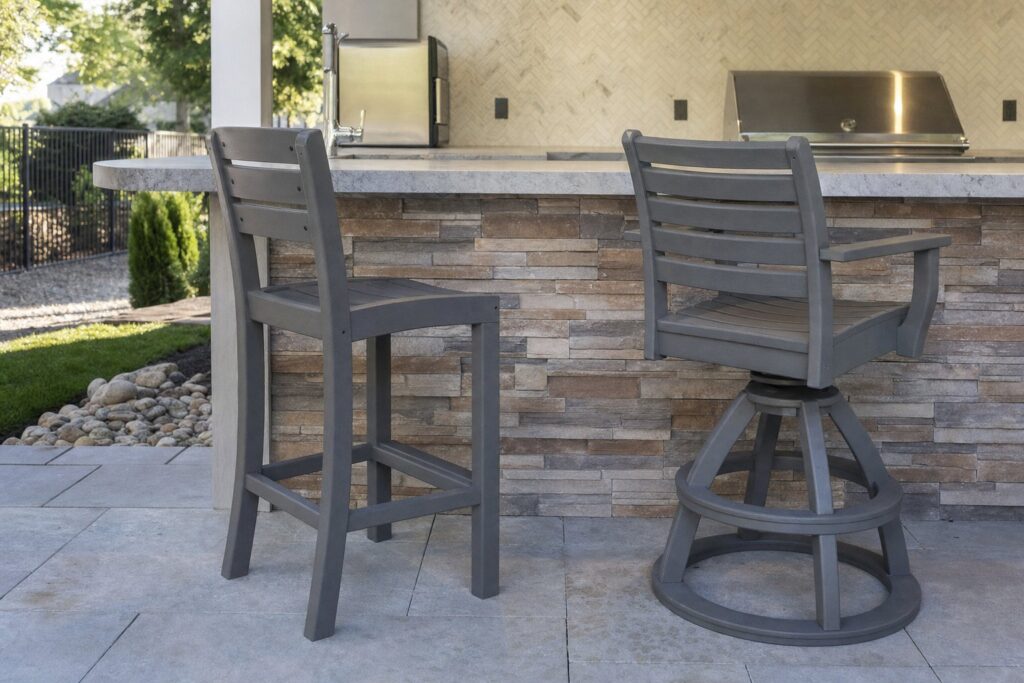
Deciding between swivel versus stationary outdoor counter stools sounds like a small detail, but it shapes how comfortable your outdoor kitchen bar feels every single day. Swivel seats let you spin to join a conversation, reach a cooler, or push back without scooting the whole stool. Stationary seats eliminate moving parts entirely, which changes the maintenance picture and can affect long-term stability in outdoor conditions. This article walks through clearance requirements, weather exposure, material trade-offs, and practical use patterns so you can settle on the configuration that actually fits your space—before you buy.
What “Counter Height” Actually Means Outdoors
The term counter height has a generally accepted meaning in the furniture industry: seat heights in the range of roughly 24 to 26 inches, designed to pair with surfaces approximately 34 to 36 inches tall. That matches standard outdoor kitchen counters, bar ledges built into deck railings, and many freestanding prep carts. Always measure your actual surface height before ordering, because there is no single universal standard and individual builds vary.
The key clearance rule of thumb is 9 to 12 inches between the seat top and the underside of the counter above it. Too little clearance and you end up hunched; too much and your arms float uncomfortably high. If you are shopping for a stationary option, the Plastic Furniture To Go Counter Height Stool sits at a verified 25-inch seat height—measure your counter and run the clearance check before committing.
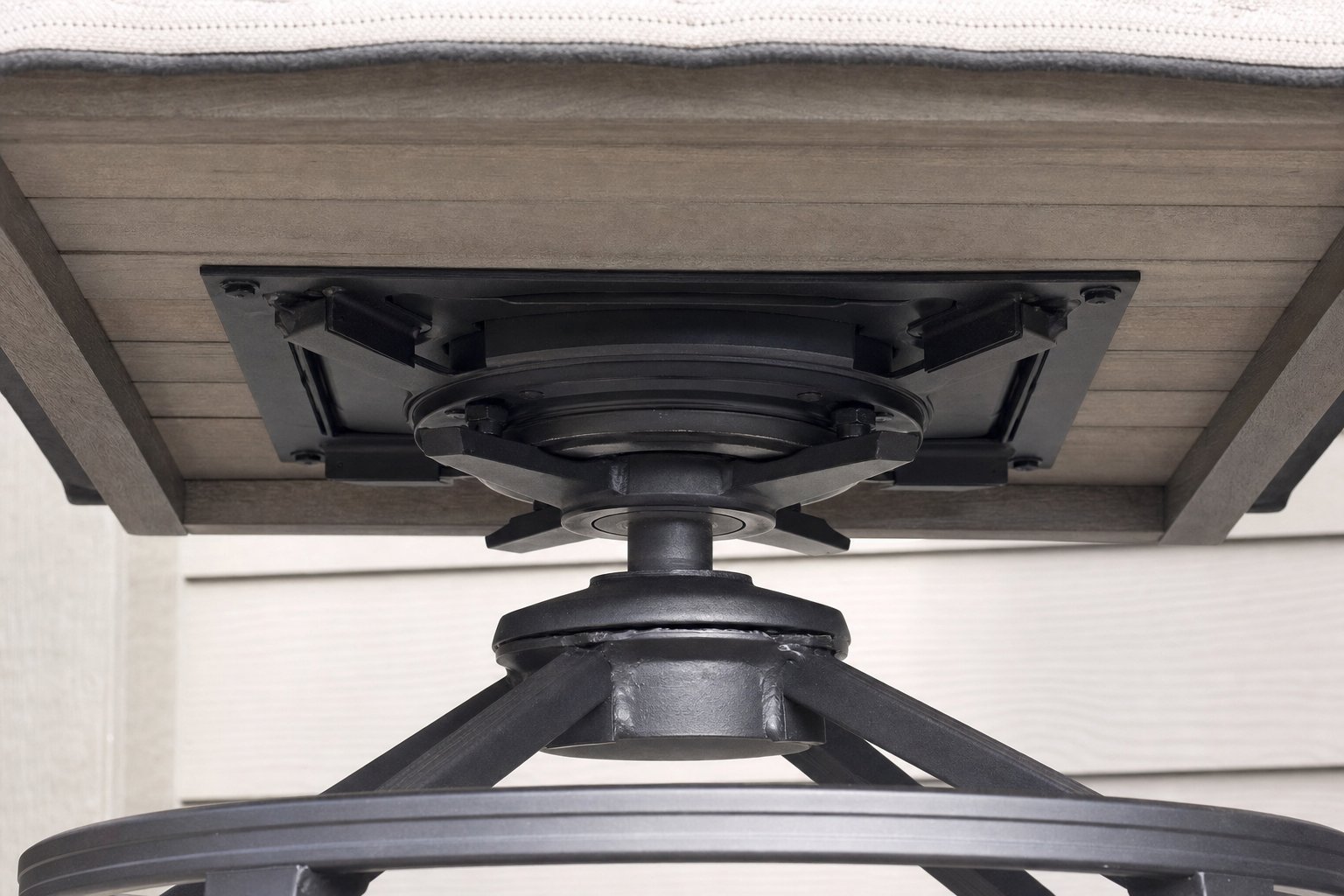
Swivel stools may add a fraction of an inch to the seat height depending on how the swivel plate is mounted beneath the seat cushion or seat pan. Confirm the seat height measurement with swivel hardware included, not the base measurement alone.
How a Swivel Mechanism Changes Your Daily Use
The functional appeal of a swivel seat is straightforward: you can rotate to talk to someone standing behind the counter, face the grill, or turn toward a guest without dragging the stool across your deck surface. For an L-shaped or U-shaped outdoor kitchen where activity happens on multiple sides, that rotational freedom can feel genuinely useful rather than merely convenient.
Ergonomics researchers note that being able to reposition naturally during seated tasks reduces the tendency to hold awkward static postures. The NIOSH ergonomics overview describes how workstation design influences posture and movement, and the same logic applies when you are seated at an outdoor counter for an extended cookout or meal. None of this means a swivel stool is medically superior—it simply means that the ability to turn without lifting matters more than it might appear.
The trade-off is mechanical. Every swivel plate, bearing race, or lazy-susan ring is a moving component exposed to rain, humidity, salt air, pollen, and whatever else your climate provides. Even stainless steel bearings accumulate grit, and powder-coated or painted swivel hardware can pit over seasons of real outdoor use. Maintenance intervals you would never think about indoors become a genuine consideration outside.
Swivel Versus Stationary Outdoor Counter Stools: The Weather Exposure Comparison
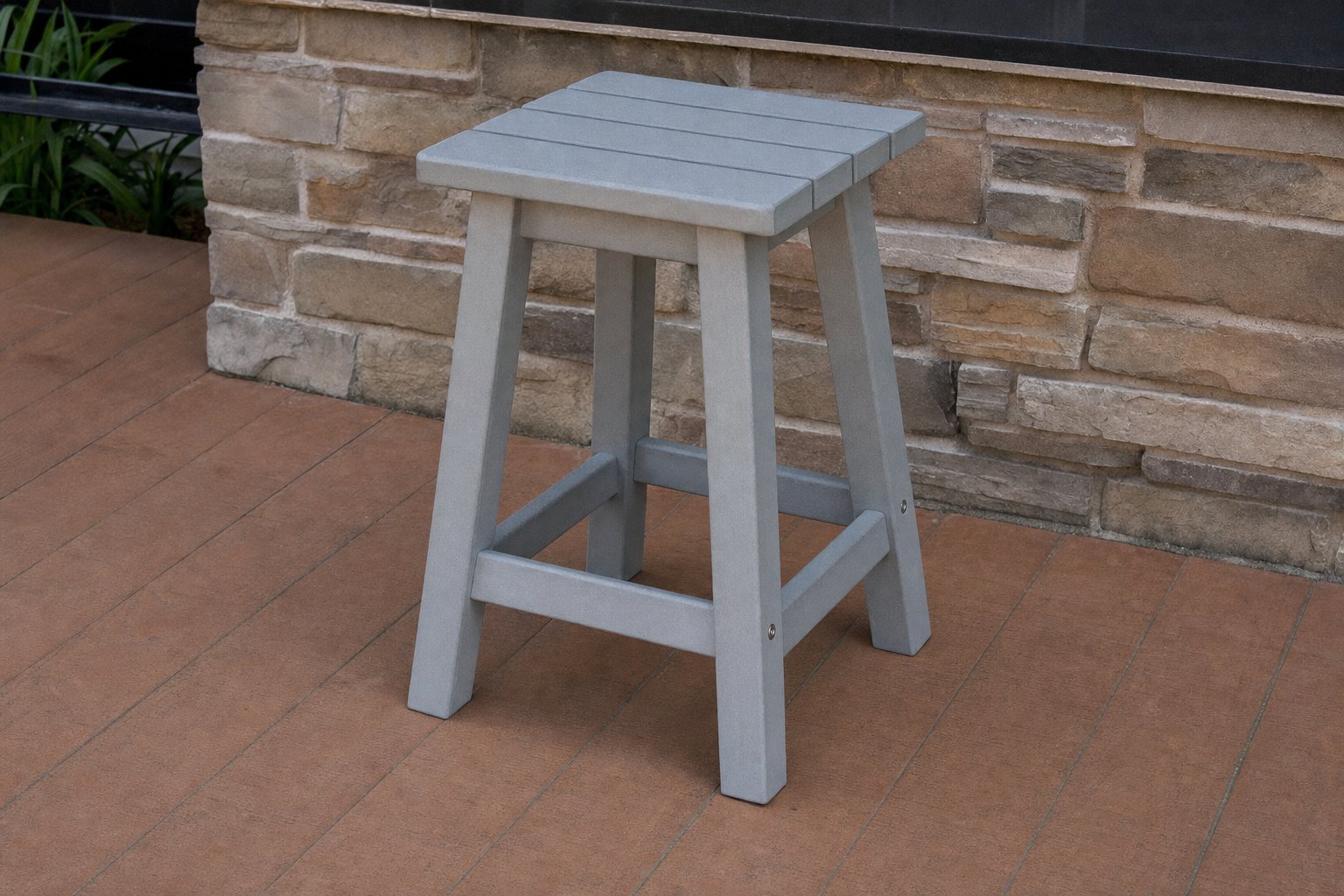
Weather exposure is where stationary stools have a structural advantage that is easy to underestimate when you are shopping indoors. A stationary stool has no moving parts below the seat. Rainwater has nowhere to pool inside a bearing housing. There is no grease to wash away, no corrosion pathway between dissimilar metals in a swivel ring, and no mechanism to seize up after a wet winter.
Swivel hardware quality varies enormously across the market. Some manufacturers use marine-grade stainless bearings and sealed races that hold up well in coastal or humid environments. Others use powder-coated carbon-steel plates that begin to surface-rust within a season or two of genuine outdoor exposure. Because the swivel assembly is usually the first component to show wear, the longevity of a swivel stool is often limited by its weakest mechanical part rather than by the seat material itself.
The word “waterproof” gets used loosely in outdoor furniture marketing. For real-world exposure—rain, morning dew, standing water after a storm—”weather-resistant” is a more honest description of what durable outdoor furniture delivers. That distinction matters more for swivel mechanisms than for solid-body stationary frames, because the mechanism introduces joints and cavities that solid construction avoids entirely.
Space and Clearance Planning for Each Style
Swivel stools need lateral clearance that stationary stools do not. When someone swings around on a swivel seat, the seat footprint effectively expands in every direction. A good planning rule is to add at least 6 inches of buffer on each side beyond the seat diameter when you are spacing swivel stools along a counter run. For a compact outdoor kitchen or a narrow bar ledge on a small deck, that extra buffer can make the difference between a layout that flows and one that feels crowded.
Stationary stools sit where you put them and stay there. You still need reasonable spacing—roughly 26 to 30 inches center-to-center is a common guideline for seated comfort at a bar—but you are not planning for rotational sweep. If your outdoor kitchen seating layout involves tight corners, built-in planters, or adjacent grill carts, stationary stools are simply easier to fit without conflict.
Also consider what happens when stools are pushed back from the counter. A swivel stool that is not centered when pushed back can rotate and take up more floor space than expected. Stationary stools pushed back stay predictably aligned with their original footprint.
Material Choices and Long-Term Appearance
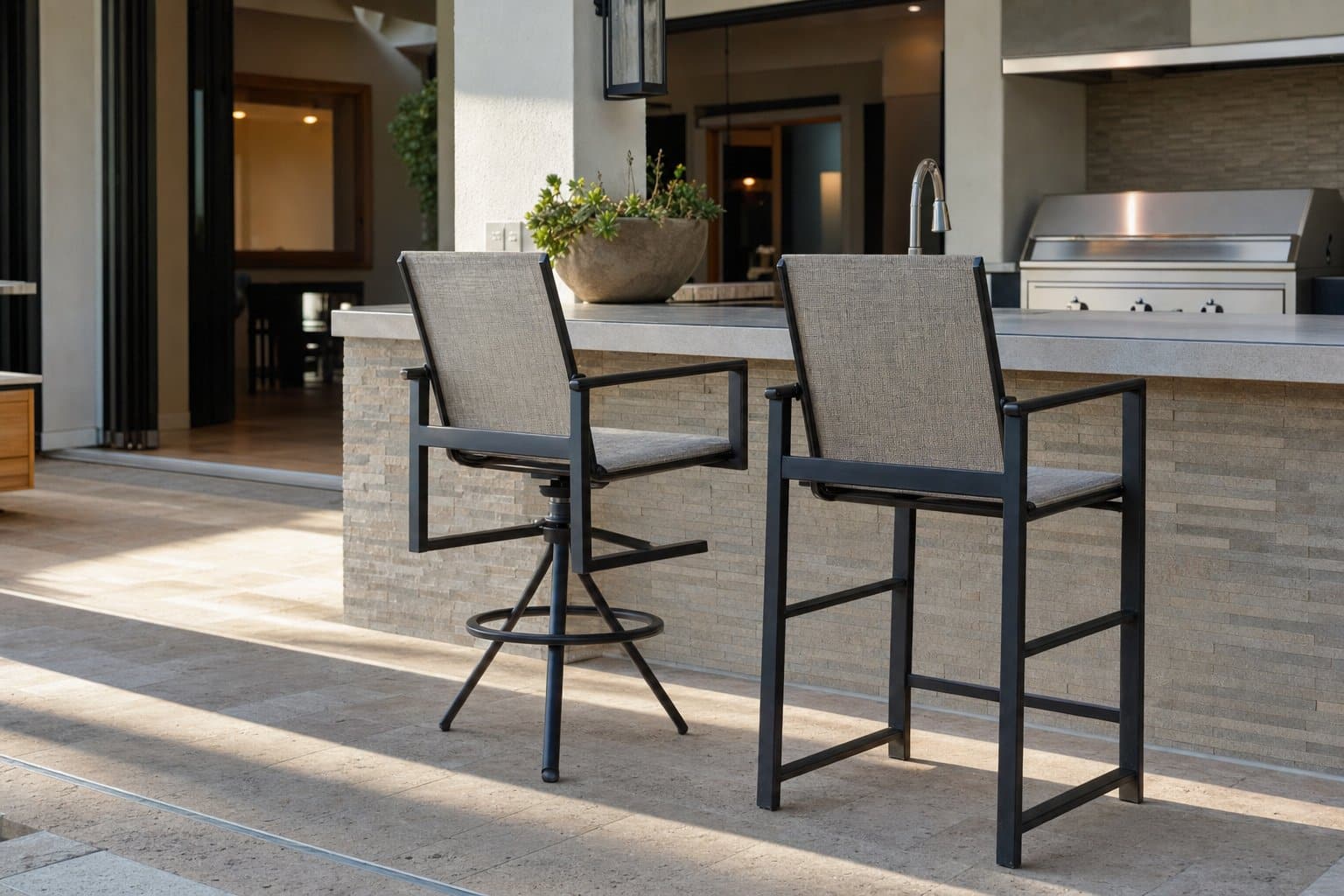
Swivel stools reach the market in a wide range of materials: aluminum frames with woven seats, teak or eucalyptus with stainless swivel hardware, powder-coated steel, and solid polymer. The frame material and the swivel hardware material should both factor into your evaluation, and they do not always match in quality. A well-constructed polymer or aluminum seat paired with a lower-grade swivel plate can still fail at the weakest link.
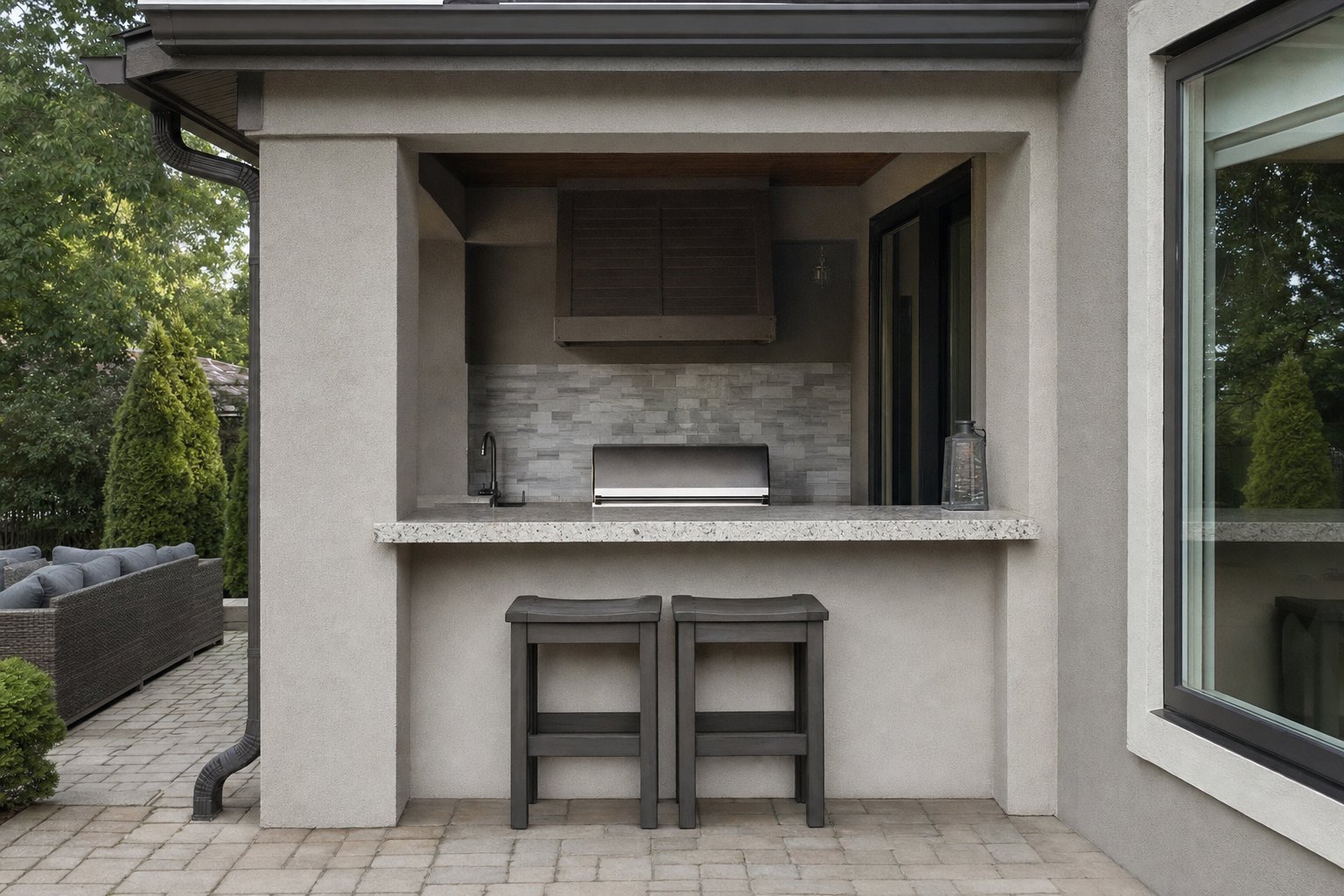
Stationary outdoor counter stools are available in the same range of materials, but without the mechanical complication. A solid-body polymer stool, for example, has no hardware below the seat exposed to pooling water. The Plastic Furniture To Go Counter Height Stool is made from Marine Grade Polymer with included 3/16-inch stainless steel hardware at the joints—a simpler construction profile than any swivel stool because there is no swivel plate to evaluate separately.
Marine Grade Polymer resists fading and moisture absorption better than wood or lower-grade plastics, though no outdoor material is entirely immune to the effects of long-term UV exposure. The material does not need seasonal sealing, painting, or cushion storage the way wood-frame furniture does, which is part of what makes it practical for permanently installed outdoor seating.
For color consistency over time, understand that any polymer furniture’s fade resistance depends on the pigment system and UV stabilizers in the specific compound—not on the category label alone. The Plastic Furniture To Go stool carries a 5-year warranty against fading and a 7-year warranty against structural defects, which gives you a concrete benchmark for evaluating comparable products.
Conversation Flow and Practical Comfort
The social geometry of outdoor seating matters more than it gets credit for. Swivel stools are genuinely better for spaces where seated guests need to turn frequently—watching a game on an outdoor TV while also accessing the counter, for example, or sitting at a corner position where two activity zones meet. The ability to turn without standing up keeps conversation more fluid when the action shifts.
Stationary stools work well when the seating orientation is clear and consistent: everyone faces the counter, the grill is in front of the cook, and guests sit to watch or chat from a fixed vantage point. Many outdoor kitchen setups fit this description. If your layout is essentially linear—a straight counter run with activity on one side—stationary seating is rarely a limitation in practice.
Backless stationary stools like the PFTG Counter Height Stool work best when the counter itself provides some forearm support or when guests are seated for shorter intervals rather than long dinners. If your use case involves extended seating, consider whether a backed stool is available in the swivel style you are evaluating, and measure its seat height with the same care.
Assembly, Warranty, and Purchasing Logistics
Most outdoor counter stools—swivel or stationary—ship knock-down and require some assembly. Swivel stools typically add steps: attaching the swivel plate to the base, then to the seat, and verifying that the rotation is smooth and centered before the stool goes into service. That is usually not complicated, but it is more involved than assembling a fixed-seat stool with a handful of fasteners.
The Plastic Furniture To Go Counter Height Stool ships in a box with included stainless steel hardware and is designed for assembly in approximately 20 minutes. Orders ship within 3 business days, with carrier transit of 2 to 7 business days and a displayed delivery window of 5 to 10 business days. Shipping is free to the contiguous U.S. Returns are accepted within 30 days of receipt for products that are new, unused, and unassembled in original packaging with proof of purchase—the customer covers return packaging and freight except in cases of seller error, and refunds exclude the original shipping cost.
When comparing warranties across swivel and stationary options, look specifically for what the structural warranty covers. Some warranties exclude the swivel mechanism as a “wear component.” A warranty that explicitly covers the mechanism gives you meaningfully more protection than one that only covers the frame.
Frequently Asked Questions
Do swivel stools cost significantly more than stationary counter stools?
Generally, yes. The swivel mechanism adds manufacturing cost, and higher-quality sealed bearings add more. Budget for a meaningful price premium over a comparable stationary stool. If your use case does not genuinely require rotation—such as a straight counter run with a fixed activity orientation—that premium may not return value over the life of the furniture.
Can I use an indoor swivel stool outdoors if I bring it in during bad weather?
Indoor stools are typically built to different standards for frame material, hardware corrosion resistance, and seat material UV stability. Even with careful storage, repeated exposure to humidity, pollen, and temperature swings wears indoor finishes faster than outdoor-rated finishes. Look for products explicitly rated for outdoor use rather than adapting indoor pieces.
Is a backless stationary stool suitable for a full outdoor dinner party?
It depends on your guests and the duration of the meal. Backless stools work well for casual use and shorter intervals but can become tiring for extended seating without lumbar support. If long dinners are common, a backed counter stool—swivel or stationary—is worth the additional research, and you should verify the seat height against your specific counter before ordering.
How do I know if my outdoor counter is the right height for a 25-inch stool?
Measure from the floor to the underside of your counter surface. Subtract the stool’s verified seat height—25 inches for the PFTG Counter Height Stool—and you have your knee clearance. The generally accepted comfortable range is 9 to 12 inches. If your counter measures roughly 34 to 37 inches from the floor, a 25-inch seat height typically falls within comfortable range for most adults.
Still weighing your options or unsure how a specific stool will fit your counter setup? Contact Plastic Furniture To Go with your counter height and layout dimensions and the team can help you confirm fit before you order. When you are ready to browse, the full selection is available in the Plastic Furniture To Go shop.
You may also find these helpful: Weatherproof Outdoor Bar Stools, Heavy-Duty Plastic Patio Chair Specs: 7 Checks, and Waterproof Outdoor Side Tables.

