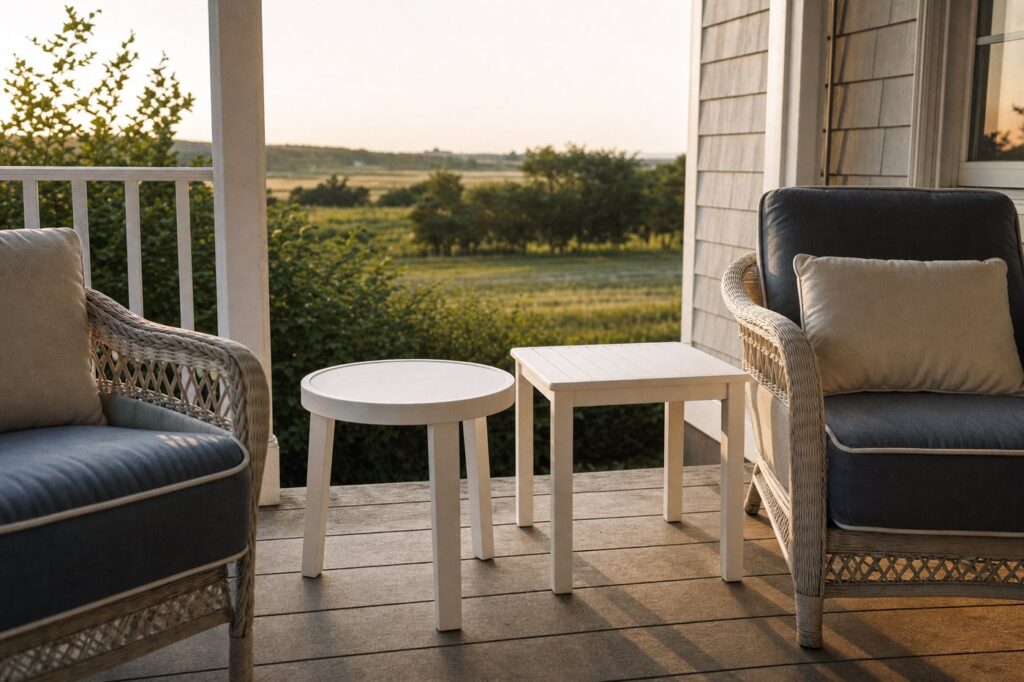
An end table seems like the smallest decision in outdoor furniture shopping, right up until you’re standing in your own patio trying to picture where it will actually go. Round or square isn’t just a style preference — it changes how the table fits into tight spaces, how it feels next to your seating, and how safe it is around high-traffic areas. Here’s how to think through the choice using our Hampton Round End Table and Hampton Square End Table as the comparison.
Both Tables Share the Same Foundation
Both Hampton end tables use Marine Grade Polymer and 3/16-inch stainless steel hardware, weigh 15 lb, and are American Made. Both carry seven-year structural and five-year fading coverage under the same written policy. Compare the actual tabletop shape and dimensions with your layout; these shared facts do not establish identical performance or lifespan.
Round Tables: Better for Tight or High-Traffic Spaces
A round table has no corners, which matters more than it might seem. In a smaller patio, a narrow side yard, or a spot near a walkway, a round table lets people pass closer to it without catching a hip or shin on a sharp edge. That makes it a practical choice near pool decks, on narrow balconies, or anywhere kids or pets move through the space quickly.
Round tables also tend to read as softer and more casual, which pairs well with curved seating like an Adirondack chair or a rounded lounge chair, echoing the table’s own shape.
Square Tables: Better for Corners and Structured Layouts
A square table fits flush against a straight-backed sofa, a wall, or the arm of a sectional in a way a round table can’t. If you’re setting up a matched, symmetrical outdoor living area — say, a sofa and two chairs around a coffee table, with end tables bookending the sofa — the straight edges of a square table line up cleanly with straight furniture edges and keep the whole layout looking intentional rather than scattered.
Square tables also tend to hold slightly more usable surface area in the same footprint, since there’s no curved edge cutting into the corners, which can matter if you’re using the table to hold a full drink, a book, and a phone all at once.
Think About What Sits Next to It
The chair or sofa beside the table matters as much as the table itself. Pair a round table with rounded seating and the whole grouping feels cohesive. Pair a square table with structured, straight-lined furniture and the same thing happens in a more architectural way. Mixing shapes isn’t wrong, but if you want a pulled-together look rather than an eclectic one, matching the table’s shape to your seating’s lines is the simplest way to get there.
Measuring Before You Buy

Whichever shape you choose, measure the actual gap where the table will sit, not just the general area. Leave enough space on at least one side for someone to reach a drink or set something down without bumping a neighboring chair. Both the Hampton Round and Hampton Square are side/end tables; compare their published dimensions with your available space.
Include the objects you actually use in the layout test. Place your usual tray, book, or unbreakable cup on a cardboard outline of the proposed tabletop while the outline rests on an existing supported surface. Check the arrangement from the seated position instead of standing over it. Keep everyday items within a comfortable reach and away from the edge. The useful comparison is whether each model accommodates your routine, rather than whether one shape looks larger in a photograph.
Durability Outdoors, Either Shape
Follow the care and seasonal-storage guidance for each table. Rain, sun, hardware condition, surface support, and severe weather all matter. Neither material nor tabletop shape guarantees that a piece cannot be damaged or removes the need for a storage plan.
The shared hardware specification is a fact to record alongside dimensions and written coverage. It does not prove that the two models will perform identically or last the same number of years. Choose by fit and intended use, and inspect each table’s condition during ownership.
Using Two Tables Together
Some outdoor layouts benefit from one of each shape rather than choosing a single style for the whole space. A round table beside a curved lounge chair on one side of a seating area, paired with a square table anchoring a straighter sofa arrangement on the other, can look intentional rather than mismatched, especially if both tables share the same color and material finish. The consistency of the material carries the look even when the shapes differ.
If you’re furnishing a larger patio in phases — adding pieces over more than one season — buying one of each shape early gives you the flexibility to decide later which one fits best next to whatever seating you add down the line, rather than locking in a shape decision before the rest of the layout exists.
Height and Proportion Relative to Seating
Beyond shape, it’s worth checking that an end table’s height works with the chair or sofa arm it will sit beside. A table that sits noticeably below or above the arm of an adjacent chair can look and feel out of proportion, even if the shape is otherwise a good fit for the space. Both the Hampton Round and Hampton Square are sized to pair naturally with standard-height outdoor lounge seating, so this is less of a concern than it would be mixing furniture from several different brands and product lines. Painter’s tape or flattened cardboard makes the shape decision easier than estimating from a product photo. Mark the full tabletop outline, place the neighboring chairs where they will actually sit, and walk the route while carrying a drink or small tray. The U.S. Access Board’s outdoor guidance illustrates why approach space and knee and toe clearance matter around tables. A private patio may not be governed by those federal standards, but the same planning idea helps keep a table from blocking the user who needs the clearest route. A round outline usually softens a tight turning point, while a square outline offers more usable corner space for a lamp, book, or serving tray. Repeat the test with chairs pulled slightly away from their normal positions; that temporary movement is when an end table most often becomes an obstacle. Photograph the taped layout from the main doorway and seating position before ordering. That second view often reveals a blocked path or awkward reach that is easy to miss while standing directly over the outline.
Frequently Asked Questions
Do the round and square tables weigh the same?
Yes, both the Hampton Round End Table and Hampton Square End Table weigh 15 lbs.
Which one is better for a small patio?
A round table generally works better in tight or high-traffic spaces since it has no corners to catch on as people pass.
What’s the warranty on both tables?
Both carry a 7-year structural warranty and a 5-year fading warranty, with full terms on our returns and warranty page.
Are they made from the same material?
Yes, both are Marine Grade Polymer with 3/16″ stainless steel hardware, American made.
Where can I compare current pricing?
Visit our shop to see both tables side by side, or read our about page to get to know our family-owned company.