
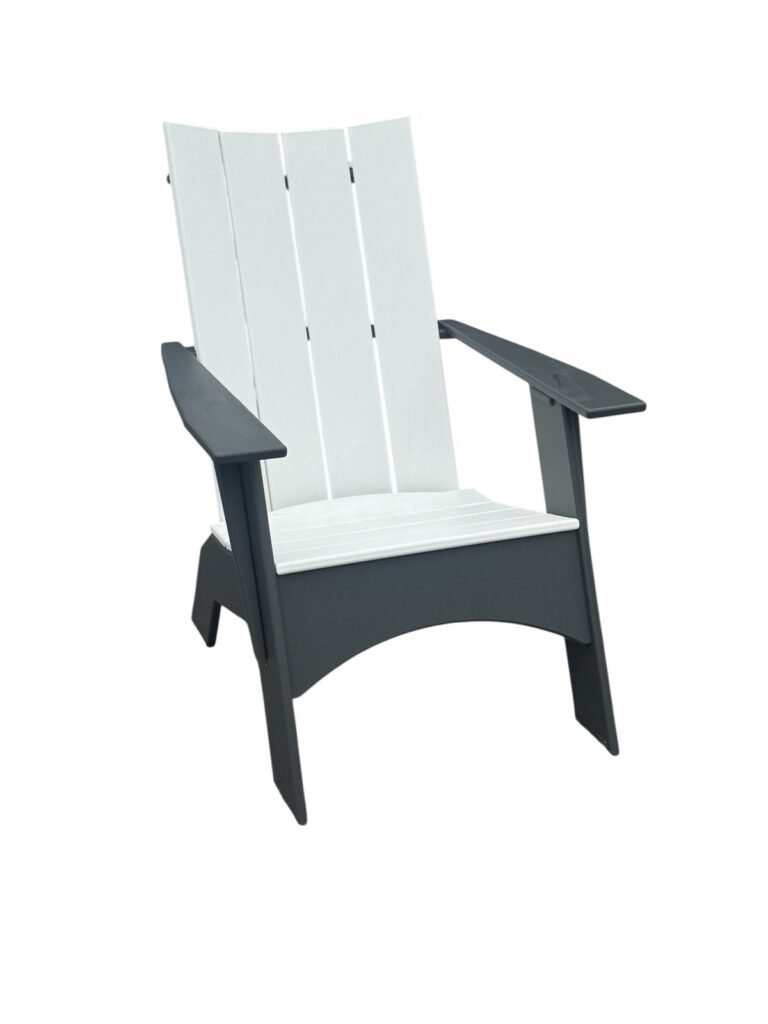
The Hampton Adirondack Chair is one of the heavier pieces in our lineup at 52 lb — by design. That weight is what keeps a wide, deep-seated chair planted on a deck or lawn instead of tipping or sliding in a stiff breeze. But it also means moving it takes a little more planning than a lightweight accent chair. Here’s what to expect.
Why This Chair Is Built Heavier on Purpose
An Adirondack chair’s low, reclined seat and wide armrests create a lot of surface area for wind to catch, especially compared to a low-profile dining chair. The Hampton Adirondack Chair’s weight is part of what keeps it stable in that shape — a lighter chair with the same proportions would be more prone to tipping in a gust or sliding across a smooth deck surface. If you’ve ever chased a cheap resin Adirondack chair across the yard in a windstorm, this is the tradeoff that solves it.
Moving It Solo vs. With Help
For general guidance on lifting technique and avoiding strain when moving heavier household items, the CDC’s National Institute for Occupational Safety and Health publishes safe-lifting fundamentals that apply just as well to furniture as to workplace tasks.
Most people can lift and reposition the chair alone for short distances — sliding it a few feet to chase shade, or turning it to face a different direction — especially by gripping the wide armrests, which give a solid hand-hold. For longer moves, like carrying it from a garage to a patio at the start of the season, two people make the job easier and reduce the chance of scraping it against a doorframe or dropping a corner.
We don’t publish a weight-capacity rating for the chair itself. If that’s part of your decision, our contact form is the fastest way to get a direct answer before ordering.

Seasonal Storage Tips
Because it’s built from Marine Grade Polymer, the Hampton Adirondack Chair doesn’t require indoor winter storage the way wood furniture does — it’s designed to stay outside year-round without cracking, rotting, or fading beyond its 5-year fading warranty terms. That said, if you do want to store it seasonally to free up deck space, a few tips make the process easier: clear a flat storage spot against a wall before moving day so you’re not searching for space mid-carry, and stack multiple chairs back-to-front rather than side-by-side to save floor space in a garage or shed.
The chair ships knock-down and assembles in about 20 minutes with the included 3/16″ stainless steel hardware — worth knowing if you ever want to disassemble it partially for a tighter storage footprint, though most customers leave it fully built once assembled.
Built to Handle the Move
The same 3/16″ stainless steel hardware that holds the chair together during assembly keeps joints tight through repeated repositioning. Because the color runs through the Marine Grade Polymer material rather than sitting on top as paint, scuffs from dragging or bumping the chair against a doorframe don’t expose a different color underneath — a practical benefit when the chair gets moved several times a season.
Comparing to Other Adirondack Chair Materials
Solid wood Adirondack chairs often weigh in a similar range, sometimes heavier depending on the wood species, but they also demand more upkeep to justify that weight — periodic sealing, sanding, and repainting to prevent rot and splintering. Thin resin Adirondack chairs, by contrast, are often under 20 lb, light enough to be genuinely easy to move but also light enough to tip or blow across a deck in moderate wind. The Hampton Adirondack Chair’s 52 lb sits deliberately between those two extremes: heavier than a flimsy resin shell for real stability, but without the ongoing maintenance a solid wood chair requires to stay in good condition.
Using a Dolly or Furniture Slider for Frequent Moves
If you find yourself repositioning the chair often — chasing shade throughout the day, for example — a simple set of furniture sliders under each leg can make repeated moves effortless even at 52 lb, letting you slide rather than lift. This is a common solution for households that like to rearrange a seating area daily without the physical effort of a full lift each time.
Lifting Technique That Protects Both You and the Chair
When a two-person lift is warranted, the safest grip points are the wide armrests and the base of the front legs, rather than the seatback or slats, which aren’t designed to bear the chair’s full weight as a lifting point. Bend at the knees rather than the back, and communicate a clear count before lifting together so both people move at the same time — a mismatched lift is more likely to result in a dropped corner than the weight itself.
If you’re carrying the chair through a doorway or up stairs, tilting it slightly on its side (rather than trying to carry it fully upright) often clears tight spaces more easily, since the chair’s width at the arms is usually the limiting dimension in a narrow hallway. Stairwells add an extra variable worth planning for ahead of time: measure the narrowest point of the stairwell, including any turn or landing, rather than just the width of the stairs themselves, since a tight 180-degree turn at a landing is often the real bottleneck rather than the stair run. Two people moving the chair together can rotate it through a turn far more easily than one person alone, especially when the path isn’t a straight shot from door to destination. If the chair is headed into seasonal storage rather than just across a room, a garage, shed, or covered patio corner all work fine. Before choosing a storage spot, walk through the same access considerations as the move itself — a narrow shed doorway or a tight path around other stored items can turn what should be a quick seasonal move into another lift-and-maneuver situation, so it’s worth picking a spot that’s as easy to reach as the chair’s final resting place. Wiping the chair down before extended storage — clearing off pollen, dust, or leaf debris — keeps it from tracking residue onto or into a storage space, though this step is about cleanliness rather than necessity, since the chair itself doesn’t need protection from the elements year-round.
Delivery Timing
Orders ship free to the contiguous U.S., generally within 3 business days of handling plus 2–7 business days of carrier transit — a total window of roughly 5–10 business days. It’s backed by a 7-year structural warranty and a 5-year fading warranty; details are on our returns and warranty page.

Frequently Asked Questions
Can I move the chair alone, or do I need help?
Most people can lift and reposition it solo for short distances using the armrests as handholds; longer carries are easier with two people.
Does the chair need to come inside for winter?
No — Marine Grade Polymer is designed for year-round outdoor exposure.
Will moving the chair often loosen the hardware faster?
Normal repositioning shouldn’t meaningfully speed up wear on the 3/16″ stainless steel hardware; it’s built to handle repeated movement as part of standard use, not just static placement.
Is the 52 lb weight the same across all available colors?
Yes — weight is determined by the chair’s dimensions and panel thickness, not the color finish, so it stays consistent across the full color lineup.
Does the chair feel heavier once fully assembled versus in the box?
No — the 52 lb figure is the assembled chair’s total weight, so there’s no surprise jump in weight once assembly is complete; the boxed components add up to the same total.
See the full Hampton Adirondack Chair listing or browse our complete outdoor furniture collection.

